How Long Does It Take to Drive Route 66? Full Route, Partial Trips, and Everything In Between
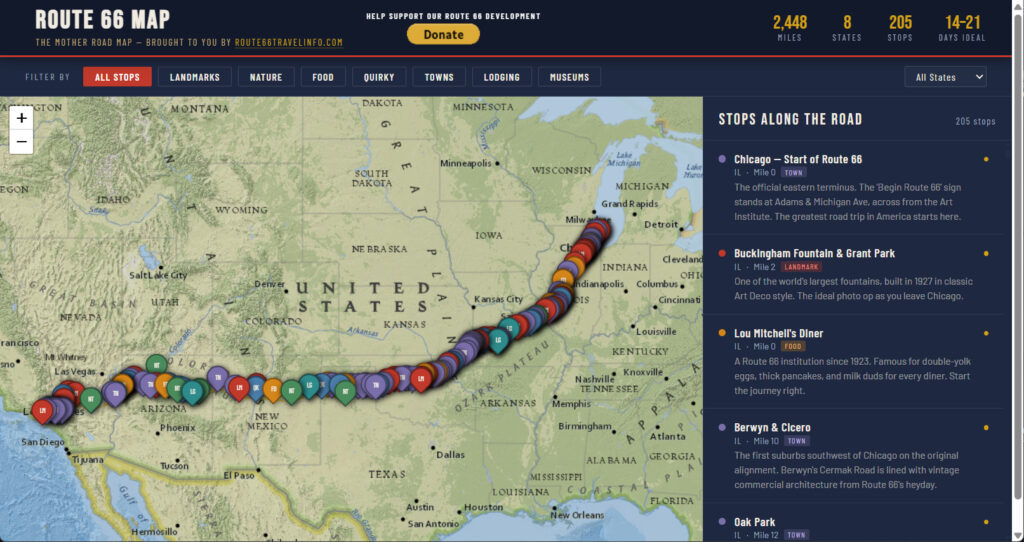
The single most common question every Route 66 trip planner asks is also the one with the most variable answer: how long does it take? The Mother Road stretches 2,448 miles from the Begin Historic Route 66 sign in Chicago, Illinois to the End of the Trail at the Santa Monica Pier in California, crossing eight states, four distinct climate zones, and more than a century of American roadside history. The minimum possible driving time — ignoring sleep, food, fuel, and every single thing that makes Route 66 worth driving — is roughly 33–36 hours of pure highway time. Nobody actually drives it that way.
The more honest and useful answer is this: most first-time Route 66 travelers need a minimum of 14 days to drive the full route with any satisfaction, and three weeks is the sweet spot for a trip where you actually experience the road rather than just complete it. But Route 66 is not a single trip for most people — it is a series of trips. Partial routes, single-state explorations, and regional segments are how many of the most devoted Route 66 travelers know the highway best. This guide gives you the honest numbers for every scenario — so you can match the road to the time you actually have.
Route 66 Drive Time: Quick-Reference Guide
Use this table to identify the trip type that fits your available time, then read the detailed breakdown for your scenario below.
| Time Available | Daily Miles | Trip Type | Best For |
| 2 weeks (14 days) | ~175 mi/day | Full route — fast pace | Best for: First-timers who want the complete coast-to-coast experience |
| 3 weeks (21 days) | ~115 mi/day | Full route — relaxed pace | Best for: Travelers who want to stop everywhere and feel no rush |
| 4+ weeks | Under 90 mi/day | Full route — deep dive | Best for: Retirees, remote workers, history obsessives |
| 10 days | ~245 mi/day | Full route — very fast | Best for: Experienced road-trippers; skips many side stops |
| 7 days (1 week) | One or two states | Partial route | Best for: Regional exploration — IL+MO, OK+TX, NM+AZ, or AZ+CA |
| 3–5 days | Single state | Partial route | Best for: Weekend or long-weekend deep dives |
| 1–2 days | Single corridor | Day trip / overnight | Best for: Local explorers — Chicago, LA basin, Oklahoma City, Albuquerque |
Driving the Full Route: Chicago to Santa Monica
The full Route 66 runs approximately 2,448 miles — though the precise number varies slightly depending on which historical alignments you follow through each state. The federal highway ran from Chicago, Illinois to Santa Monica, California from its commissioning on November 11, 1926 until its official decommissioning in 1985. Today the route is preserved as a series of historic alignments that parallel Interstate 40 (and other interstates) for most of its length. Driving those two-lane alignments — rather than blasting down I-40 — is what makes Route 66 a road trip rather than a commute, and it is also what makes accurate time estimates so difficult: a stretch that covers 30 map miles can take two hours on a winding two-lane historic alignment through the Oklahoma hills or the Arizona mountains.
The Minimum: 10 Days (Not Recommended for First-Timers)
A determined, experienced road tripper who has pre-researched every stop and is willing to drive 240–250 miles per day can complete the full Route 66 in approximately 10 days. At this pace, you will see the road. You will hit the most iconic stops — Cadillac Ranch, the Painted Desert, the Wigwam Motel, the Santa Monica Pier. But you will skip most of the two-lane alignments in favor of the interstate, you will drive past countless historic structures you later wish you had stopped at, and you will arrive in Santa Monica having completed Route 66 but not quite having experienced it. Ten days is the floor, not the target.
The Standard: 14 Days (Two Weeks)
Two weeks — 14 days — is the most commonly cited minimum for a satisfying full-route experience. At an average of 175 miles per day, this allows time for the two-lane historic alignments in every state, meaningful stops at the major attractions, overnight stays at iconic Route 66 motels (rather than just whatever chain hotel is nearest the interstate), and the spontaneous diversions — the unmarked diner, the abandoned motel, the local who gives you directions to a section of original roadbed — that are the actual substance of a Route 66 trip.
A sample 14-day structure:
- Days 1–2: Illinois — Chicago to Springfield to the Missouri border (~300 miles). The Illinois Route 66 corridor includes the Gemini Giant in Wilmington, Funk’s Grove, and the Lincoln sites in Springfield.
- Days 3–4: Missouri — St. Louis through the Ozarks to Joplin (~317 miles). The Missouri Route 66 corridor includes the Chain of Rocks Bridge, Meramec Caverns, and the Cuba murals. The Ozark two-lane alignments add significant time — budget it.
- Day 5: Kansas + into Oklahoma — Galena through Kansas (just 13 miles) and deep into Oklahoma (~150 miles). Do not skip Kansas — the Rainbow Bridge and the Galena Mining Museum are genuine Route 66 treasures in miniature.
- Days 6–7: Oklahoma — The longest original Route 66 mileage of any state (~400 miles). Oklahoma’s Route 66 corridor deserves two full days: the Blue Whale of Catoosa, Pops 66 in Arcadia, the National Route 66 Museum in Elk City, and Totem Pole Park in Foyil are all worthy stops.
- Day 8: Texas — Shamrock through Amarillo to the New Mexico line (~178 miles). Texas is shorter than most expect but packs in Cadillac Ranch, the Midpoint Café in Adrian (the geographic center of Route 66), and the magnificent emptiness of the Panhandle sky.
- Days 9–10: New Mexico — The longest state mileage (~487 miles). New Mexico covers Tucumcari’s famous neon motel strip, Santa Rosa’s Blue Hole, Albuquerque’s historic Central Avenue, and the dramatic geology east and west of Gallup.
- Days 11–12: Arizona — Arizona packs more iconic Route 66 imagery per mile than any other state (~401 miles): the Petrified Forest National Park, the Painted Desert, Winslow’s Standin’ on the Corner, Flagstaff, Williams, the preserved ghost-town feel of Seligman, Kingman, and the mountain switchbacks down to Oatman.
- Days 13–14: California — Needles through the Mojave, the Inland Empire, and into Los Angeles to the Santa Monica Pier (~315 miles). Allow extra time for Los Angeles traffic — the final approach to the End of the Trail can be the slowest driving of the entire trip.
The Ideal: 21 Days (Three Weeks)
Three weeks is when Route 66 stops being a road trip and becomes an experience. At approximately 115 miles per day, the pace drops to something close to what early Route 66 travelers experienced — a day’s drive that covers one region, leaves time for conversation with locals, and allows for the unplanned overnight in a small town that turns out to be one of the best nights of the trip. Three weeks also allows for the major detours that add enormous value: a night in Chicago before the Begin sign, a day at the Grand Canyon from Williams, Albuquerque’s Old Town in depth, Palo Duro Canyon from Amarillo, and a day or two in Los Angeles before or after the Santa Monica finish.
Four Weeks and Beyond: The Deep Dive
Some Route 66 travelers — particularly retirees with time and remote workers who can carry their jobs with them — spend four to six weeks on the full route, averaging under 90 miles per day. At this pace, Route 66 becomes something closer to a residency than a road trip: you meet the people who live and work on the highway, you find the unmarked historical structures that don’t appear in any guidebook, and you discover that the most interesting things on Route 66 are often the ones that take three days to find. If your schedule allows this approach, take it — it’s the closest modern experience available to what traveling the original Mother Road actually felt like.
State-by-State: Miles, Minimum Days, and What Makes You Linger
This table provides a realistic breakdown of each state’s Route 66 mileage, the minimum days needed to drive it meaningfully, and the specific stops and alignments that consistently cause travelers to spend more time than planned.
| State | RT 66 Miles | Min. Days | Key Stops & Why You’ll Linger |
| Illinois | ~300 mi | 1–2 | Chicago Begin sign, Gemini Giant, Funk’s Grove, Springfield (Lincoln sites), Cahokia Mounds detour, Collinsville |
| Missouri | ~317 mi | 2–3 | St. Louis Gateway Arch, Chain of Rocks Bridge, Meramec Caverns, Cuba murals, Carthage, Joplin — Ozark two-lanes add hours |
| Kansas | ~13 mi | ½ day | Galena, Riverton, Rainbow Bridge — shortest state; do not skip it |
| Oklahoma | ~400 mi | 2–3 | Longest original mileage; Blue Whale of Catoosa, Pops 66, National Route 66 Museum, Totem Pole Park, countless two-lane diversions |
| Texas | ~178 mi | 1–2 | Shamrock, McLean, Amarillo, Cadillac Ranch, Palo Duro Canyon detour, Adrian (midpoint of Route 66) |
| New Mexico | ~487 mi | 2–3 | Tucumcari neon, Santa Rosa, Albuquerque’s Central Ave, Old Town, Gallup — longest state mileage |
| Arizona | ~401 mi | 2–3 | Petrified Forest NP, Painted Desert, Winslow, Flagstaff, Williams, Seligman, Grand Canyon detour, Kingman, Oatman |
| California | ~315 mi | 2–3 | Needles, Mojave desert ghost towns, Barstow, San Bernardino (Wigwam Motel), LA basin, Santa Monica Pier |
| TOTAL | ~2,448 mi | 10–21+ days | The more time you allow, the richer the trip. Rushing Route 66 defeats its purpose. |
A critical note on Oklahoma: Oklahoma has more miles of original, drivable Route 66 alignment than any other state — approximately 400 miles — and it is consistently the state where itineraries fall furthest behind schedule. The two-lane alignments through the eastern Oklahoma hills, the density of authentic Route 66 commercial structures, and the sheer number of genuinely interesting stops mean that travelers who budget one day for Oklahoma almost always wish they had budgeted two. Plan for two days in Oklahoma regardless of your overall timeline.
A critical note on the California finish: Los Angeles traffic is a variable that no itinerary can fully account for. The Route 66 corridor through the Los Angeles basin — from San Bernardino through Pasadena, Arcadia, Monrovia, Azusa, Duarte, Irwindale, Baldwin Park, El Monte, and into downtown — passes through one of the most congested urban traffic environments in the United States. Budget a minimum of 3–4 hours for the final 60 miles of Route 66 in California, and more if you’re arriving during weekday rush hours.
Partial Route Trips: One Week or Less
Most Route 66 travelers do not drive the full 2,448 miles in a single trip — and there is no rule that says they should. The highway’s eight states are each distinctive enough to reward a focused exploration, and several regional pairings offer outstanding self-contained road trip experiences that can be completed in one week or a long weekend. These are the most popular partial-route options, with honest time estimates for each.
The Western Desert: New Mexico + Arizona + California (7–10 Days)
For travelers flying into Albuquerque or Los Angeles, the western section from Albuquerque to Santa Monica is one of the most concentrated Route 66 experiences available in a week. The approximately 1,200 miles from Albuquerque to Santa Monica covers the Painted Desert and Petrified Forest in Arizona, the Wigwam Motel in San Bernardino, and the End of the Trail at Santa Monica. Done in 7 days at a reasonable pace (~170 miles/day) with stops at the best of New Mexico and Arizona, this is among the most scenically dramatic Route 66 road trips possible.
- Day 1: Albuquerque — Central Avenue, Old Town, Nob Hill, Route 66 neon
- Day 2: Albuquerque to Gallup via the historic alignment through Laguna, Grants, and Continental Divide (~140 miles)
- Day 3: Gallup to Holbrook, AZ via the Petrified Forest NP and Painted Desert (~130 miles — allow the full day)
- Day 4: Holbrook to Flagstaff via Winslow and the Two Guns ghost town (~100 miles)
- Day 5: Flagstaff to Kingman via Williams, Seligman, and Peach Springs (~145 miles)
- Day 6: Kingman to San Bernardino via Oatman, Needles, and the Mojave (~170 miles)
- Day 7: San Bernardino to Santa Monica via the Inland Empire, Pasadena, and Los Angeles (~90 miles — allow 4+ hours for LA traffic)
The Heartland: Oklahoma + Texas (4–5 Days)
Flying into Oklahoma City or Tulsa and driving southwest through Oklahoma and across the Texas Panhandle to Amarillo covers approximately 580 miles of Route 66 that includes: the highest concentration of original two-lane Route 66 alignment in the country (Oklahoma), the most photographed roadside art installation on the route (Cadillac Ranch), the geographic midpoint of Route 66 (Adrian, Texas), and some of the most dramatic open-sky driving on the American plains. Four to five days allows meaningful exploration of both states without feeling rushed.
The Midwest Classic: Illinois + Missouri (3–4 Days)
The Illinois and Missouri section — approximately 617 miles from Chicago to Joplin — is Route 66 at its most historically layered: Chicago’s architecture and the Begin sign, the small-town Illinois corridor through Joliet, Dwight, Pontiac, and Bloomington, Springfield’s Lincoln heritage, and then the Missouri Ozarks with their remarkable concentration of two-lane Route 66 alignments, Route 66 roadside Americana, and the Chain of Rocks Bridge over the Mississippi. Three days is the minimum; four days allows the Ozark two-lanes in full.
Single-State Explorations (2–3 Days Each)
Each of the eight states rewards a dedicated 2–3 day exploration. The best single-state experiences:
- Oklahoma — The deepest Route 66 experience per day of any state. More original alignment, more intact Route 66 commercial culture, and more authentic roadside history than anywhere else on the route. Three days barely scratches the surface.
- Arizona — The most scenically dramatic state. The Painted Desert, Petrified Forest, Flagstaff’s elevation, the preserved 1950s atmosphere of Seligman and Hackberry, and the mountain descent to Oatman. Two full days; three if adding a Grand Canyon detour.
- Missouri — The Ozark two-lane alignments are among the most beautiful driving on the entire route. Three days allows the full Missouri experience including Meramec Caverns, the Cuba murals, and the Red Cedar Inn in Pacific.
- New Mexico — Albuquerque alone merits a full day on its historic Central Avenue alignment. Add Tucumcari, Santa Rosa, and Gallup and you need three days minimum for the state’s 487 miles.
The Daily Mileage Question: How Far Should You Drive Each Day?
The standard advice for Route 66 — don’t drive more than 150–200 miles per day — comes from hard experience. The highway consistently rewards slow travel and punishes fast travel. The stops that define Route 66 trips in memory are almost never the ones that were planned. They are the abandoned gas station you pulled into on impulse, the 80-year-old diner owner who sat down and talked for an hour, the unmarked historic alignment that took you through a ghost town that wasn’t on any map. Those experiences require available time — and available time requires moderate daily mileage
Why Route 66 Miles Take Longer Than Interstate Miles
A practical reality that derails many Route 66 itineraries: historic Route 66 miles are not the same as interstate miles.
- Speed: Two-lane Route 66 alignments typically run at 45–55 mph. Interstate segments run at 70–75 mph. The same distance takes 25–40% longer on the historic alignment.
- Stop frequency: The density of interesting stops on the historic alignment is dramatically higher than on the interstate. A 30-mile section of Route 66 in Oklahoma or Missouri might have 8–10 stops worth at least a 15-minute look. At 15 minutes each, that’s 2+ hours of stop time on top of 45 minutes of drive time.
- Photo stops: Route 66 is one of the most photographed roads in the world. Budget time for spontaneous stops.
- Single-lane bridges: Several original Route 66 alignments still use single-lane or narrow two-lane bridges that require waiting for oncoming traffic.
- Seasonal road conditions: Rain, heat shimmer on the Mojave, and the occasional road closure on historic alignments all add time.
Recommended Daily Mileage by Trip Type
- First-time full route: 100–150 miles per day on the historic alignment. This sounds slow — it feels exactly right.
- Experienced driver, full route: 150–200 miles per day, mixing historic alignments with interstate connectors where the alignment is broken or missing.
- Time-constrained full route: 200–250 miles per day — achievable, but expect to feel like you rushed it.
- Partial route / single state: 80–130 miles per day — the pace that allows genuine immersion in a single state’s Route 66 culture.
Planning Around the Route 66 Centennial (2026)
Route 66 celebrates its 100th anniversary on November 11, 2026. The highway was commissioned on that date in 1926, and the Centennial year will generate the largest wave of Route 66 tourism in the highway’s modern history — events, celebrations, car shows, and gatherings across all eight states throughout the year, peaking around the November anniversary date.
If you are planning a Route 66 trip in 2026 — particularly a fall trip that coincides with the anniversary — book accommodation as far in advance as possible. The most iconic Route 66 motels (the Blue Swallow in Tucumcari, the Wigwam Motel in San Bernardino, the Munger Moss in Lebanon, Missouri) will be fully booked for Centennial season months before the dates arrive. Check the Route 66 Centennial 2026 page for the complete, up-to-date Centennial event calendar.
More Route 66 Planning Resources
Route 66 — Complete Travel Guide — The full overview of the entire 2,448-mile route: history, alignments, and what to expect in each state.
Route 66 in Illinois — The first state: Chicago’s Begin sign through Springfield, Joliet, and the Gemini Giant in Wilmington to the Missouri line.
Route 66 in Missouri — The Chain of Rocks Bridge, the Ozark two-lane alignments, Meramec Caverns, and the Cuba murals.
Route 66 in Kansas — Just 13.2 miles — but don’t skip it. The Rainbow Bridge and Galena are genuine Route 66 treasures.
Route 66 in Oklahoma — More original Route 66 mileage than any other state. The Blue Whale, Pops 66, the National Route 66 Museum, and 400 miles of two-lane history.
Route 66 in Texas — Cadillac Ranch, the geographic midpoint at Adrian, and the Panhandle sky.
Route 66 in New Mexico — Tucumcari’s neon, Santa Rosa, Albuquerque’s Central Avenue, and the high desert corridor to Gallup.
Route 66 in Arizona — The Painted Desert, Petrified Forest, Flagstaff, Seligman, Kingman, and the mountain road to Oatman.
Route 66 in California — Needles and the Mojave through the Inland Empire, Pasadena, and the Los Angeles basin to the End of the Trail at the Santa Monica Pier.
Best Time of Year to Drive Route 66 — Season-by-season weather, crowd levels, and budget guide for planning when to make your trip.
Route 66 Centennial 2026 — The 100th anniversary of Route 66 is November 11, 2026. Centennial events, celebrations, and planning resources.
Route 66 State Associations — Connect with the eight state-by-state Route 66 associations for local event calendars, membership, and preservation news.