Route 66 Packing List & Vehicle Prep Checklist: Everything You Need Before You Leave
Most Route 66 trips that go wrong do not go wrong on the road. They go wrong in the driveway — because a tire was never checked, a coolant hose was never squeezed, a quart of water was never loaded into the trunk. The Mother Road is 2,448 miles of American geography that includes the heat of the Mojave, the storms of Oklahoma, the mountain grades of Arizona, and stretches of New Mexico and Arizona where the nearest service station is 40 miles away. The travelers who have the best trips are almost always the ones who spent two hours in the garage and three hours at the kitchen table before they ever turned the key.
This guide is that two hours and three hours of preparation, done for you. It covers the complete vehicle inspection checklist — every fluid, every rubber component, every safety system that matters for a long desert road trip — and the complete packing list, organized by category so nothing gets left behind. It includes a printable master checklist and a seasonal packing adjustment guide for spring, summer, fall, and winter Route 66 conditions. Print it out. Work through it. Leave nothing unchecked. Then go drive the greatest road in America.
Route 66 Master Pre-Trip Checklist
This master checklist covers every category of preparation for a Route 66 road trip. Print this table and work through it physically — checking boxes as you go — in the week before your departure. Every item has a reason for being here.
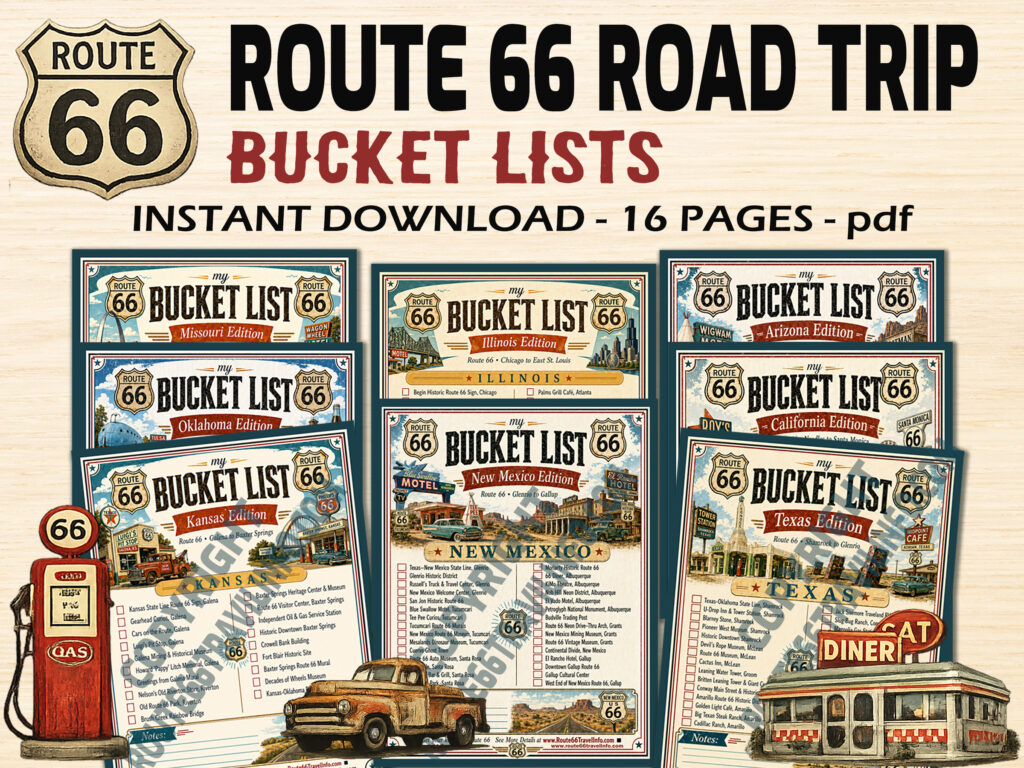
TIP FOR WORDPRESS: Consider offering this checklist as a downloadable PDF linked from the top of this article. A printable Route 66 packing checklist PDF is a high-value lead magnet and a strong SEO asset for ‘Route 66 road trip checklist’ search intent.
| ROUTE 66 MASTER PRE-TRIP CHECKLIST — Print & Check Off Before You Leave | ||
| 🔧 VEHICLE PREPARATION | ||
| ☐ Engine oil — check level & condition | ☐ Coolant — check level & condition | ☐ Transmission fluid |
| ☐ Brake fluid | ☐ Power steering fluid | ☐ Windshield washer fluid (full) |
| ☐ All 4 tires — pressure & tread depth | ☐ Spare tire — inflated & in good condition | ☐ Jack & lug wrench present |
| ☐ Tire iron / breaker bar | ☐ Belts & hoses — inspect for cracks/wear | ☐ Radiator cap — secure |
| ☐ Battery — terminals clean, charge test | ☐ Alternator — tested if belt-driven | ☐ All lights: headlights, tails, signals |
| ☐ Wiper blades — replace if streaking | ☐ Air filter — clean or replaced | ☐ Fuel filter — service if due |
| ☐ Brakes — pads & rotors inspected | ☐ Air conditioning — tested (desert essential) | ☐ Engine mounts — check if high mileage |
| ☐ Full tune-up if approaching service interval | ☐ Timing belt if within 10,000 mi of interval | ☐ Oil change done before departure |
| 🚨 SAFETY & EMERGENCY GEAR | ||
| ☐ Jumper cables or jump starter pack | ☐ Reflective road triangles or flares (3) | ☐ Fire extinguisher (ABC rated) |
| ☐ Tow rope or recovery strap | ☐ First aid kit — fully stocked | ☐ Emergency mylar blankets (2+) |
| ☐ Flashlight + spare batteries | ☐ Headlamp (hands-free) | ☐ Multi-tool or Swiss Army knife |
| ☐ Basic tool kit (screwdrivers, pliers, tape) | ☐ Duct tape — always | ☐ WD-40 or penetrating oil |
| ☐ Zip ties (assorted) | ☐ Extra fuses (check your vehicle’s sizes) | ☐ Spare serpentine belt |
| ☐ AAA membership or roadside assistance plan | ☐ Insurance card — in glove box | ☐ Roadside assistance number saved in phone |
| 💧 WATER & DESERT ESSENTIALS | ||
| ☐ 4+ gallons water in sealed containers | ☐ Personal water bottles (1 per person) | ☐ Electrolyte packets or sports drinks |
| ☐ High-SPF sunscreen (SPF 50+) | ☐ Sunglasses — UV400 rated | ☐ Wide-brim hat |
| ☐ Cooling towels | ☐ Portable battery fan | ☐ Insulated cooler with ice |
| ☐ Non-perishable emergency snacks | ☐ Protein bars (20+ for full route) | ☐ Cash for rural stations without card readers |
| 🗺️ NAVIGATION & CONNECTIVITY | ||
| ☐ Route 66 guidebook (EZ66 recommended) | ☐ Printed state-by-state maps (backup) | ☐ Phone mount for dashboard |
| ☐ Offline maps downloaded (Google/Maps.me) | ☐ Car charger for phone | ☐ Portable battery pack (20,000+ mAh) |
| ☐ Second charging cable (backup) | ☐ Route 66 app downloaded | ☐ GasBuddy app installed |
| ☐ Paper notebook + pen | ☐ Campground reservation confirmations printed | ☐ Motel booking confirmations printed/saved offline |
| 📋 DOCUMENTS & IDENTIFICATION | ||
| ☐ Driver’s license — valid & not expiring | ☐ Vehicle registration | ☐ Insurance card (physical copy) |
| ☐ Passport (if extending to Mexico or Canada) | ☐ AAA or roadside assistance card | ☐ Health insurance card |
| ☐ Emergency contact list — printed | ☐ Motel reservation list — full route | ☐ National Park passes (America the Beautiful) |
| ☐ Credit card(s) — notified of travel | ☐ Cash: $200–$300 minimum in small bills | ☐ Spare debit card in separate location |
| 👕 CLOTHING (2-WEEK TRIP) | ||
| ☐ 7 casual T-shirts / tops | ☐ 3–4 long-sleeve layers (cool desert nights) | ☐ 2 pairs jeans or travel pants |
| ☐ 1 pair shorts or light pants | ☐ 7 changes of underwear | ☐ 7 pairs socks (incl. wool for desert cold nights) |
| ☐ Light rain jacket or windbreaker | ☐ Warm layer / fleece (Flagstaff reaches 35°F in fall) | ☐ Comfortable walking shoes |
| ☐ Sandals or flip-flops | ☐ Laundry bag | ☐ Small travel umbrella |
| 🧴 PERSONAL CARE & HEALTH | ||
| ☐ Prescription medications — full supply + extra | ☐ OTC pain relievers (ibuprofen, acetaminophen) | ☐ Antihistamines (desert pollen & dust) |
| ☐ Antacids | ☐ Motion sickness medication if needed | ☐ Eye drops (dry desert air) |
| ☐ Lip balm with SPF | ☐ Hand sanitizer | ☐ Insect repellent (Oklahoma & Missouri) |
| ☐ Toiletries bag | ☐ Quick-dry travel towel | ☐ Hand wipes / cleaning wipes |
| 📷 PHOTOGRAPHY & ELECTRONICS | ||
| ☐ Camera + fully charged battery | ☐ Spare camera batteries (2+) | ☐ Memory cards — empty and ready |
| ☐ Camera bag or protective case | ☐ Tripod or mini tripod | ☐ Lens cleaning kit |
| ☐ Laptop / tablet if needed | ☐ All device chargers | ☐ Universal power strip (1 outlet → several) |
| ☐ Noise-canceling earbuds / headphones | ☐ Downloaded playlists / podcasts / audiobooks | ☐ Dash cam (highly recommended) |
| 😴 COMFORT & CONVENIENCE | ||
| ☐ Neck pillow for long driving days | ☐ Window shade for parking in desert heat | ☐ Seat cushion for long hours |
| ☐ Reusable grocery bags (2+) | ☐ Trash bags for the car | ☐ Paper towels / napkins |
| ☐ Snack organizer or car seat back organizer | ☐ Bungee cords / cargo net for trunk | ☐ Luggage locks |
Vehicle Preparation: The Detailed Guide
The vehicle inspection is the most important preparation you will do for a Route 66 trip. More than packing, more than planning, more than booking motels — the condition of your vehicle determines whether you arrive safely and on schedule or spend a day waiting for a tow truck in 115°F heat outside Needles, California. This section explains why each inspection item matters specifically on Route 66, not just on a general road trip. The desert states are genuinely unforgiving — vehicle failures that would be inconveniences elsewhere become emergencies in extreme heat far from services.
Priority-Rated Vehicle Inspection Checklist
The table below rates each inspection item by priority level for Route 66 conditions — CRITICAL items are the ones most likely to strand you or create a safety hazard in the desert. Do not skip any of them.
| Inspection Item | Priority | What to Check & Why It Matters on Route 66 |
| Cooling system | CRITICAL | The single most important pre-trip check for desert driving. Inspect the radiator, hoses (squeeze them — soft/mushy = replace), coolant level and color (should be bright green or orange, not brown/rusty), and the radiator cap seal. An overheating vehicle in the Arizona desert at 115°F is a medical emergency, not just a roadside inconvenience. |
| Tires (all 4 + spare) | CRITICAL | Check tread depth with a penny (Lincoln’s head disappears = adequate; visible head = replace). Check pressure when cold — Route 66 desert temperatures cause significant pressure increase. Inspect sidewalls for bulges, cracks, or embedded objects. Inflate the spare to spec — it is useless if it is flat when you need it. |
| Engine oil | CRITICAL | Check level and condition on a cold engine. Dark brown or black oil = overdue for change. Milky or frothy oil = possible head gasket issue (do not drive). Change the oil before departure if within 2,000 miles of the next service interval — do not start a 2,448-mile trip with 1,500 miles left on the current oil. |
| Battery & electrical | HIGH | Have the battery load-tested at any auto parts store (free at AutoZone, O’Reilly, Advance Auto). A battery that ‘seems fine’ at home can fail when subjected to extreme desert heat. Clean corrosion from terminals. Check alternator output if battery is more than 4 years old. |
| Air conditioning | HIGH | Non-negotiable for desert sections. Test the A/C thoroughly before departure — it should cool to 45°F or below at the vent on a warm day. If it struggles, have the refrigerant charge and compressor checked. A failed A/C in Needles, California (regularly 115°F+) is a serious safety situation, especially for children, elderly passengers, or pets. |
| Brakes | HIGH | Have brake pads and rotors inspected. The mountain descents on Route 66 — particularly the Oatman grade in Arizona — put significant load on brake systems. Worn pads that might last another month of city driving can fade dangerously on a mountain grade in desert heat. |
| Belts & hoses | HIGH | Inspect all rubber components: serpentine belt (check for cracking, glazing, or fraying), radiator hoses (firm, not spongy or cracked), heater hoses, and any vacuum lines visible in the engine bay. Carry a spare serpentine belt — it is cheap, lightweight, and a broken belt leaves you stranded. |
| Timing belt | HIGH | If your vehicle has a timing belt (not chain) and you are within 10,000–15,000 miles of the replacement interval, replace it before the trip. A broken timing belt destroys the engine on interference-type motors. Not a risk worth taking in the middle of the Mojave. |
| Wheel bearings & suspension | MODERATE | Listen for humming or grinding at highway speed (wheel bearings) or clunking over bumps (worn struts or ball joints). The two-lane Route 66 alignments can be rough — particularly in New Mexico and Oklahoma — and suspension issues worsen with mileage. |
| All lights | MODERATE | Walk around the vehicle and test: headlights (high and low), taillights, brake lights, turn signals, reverse lights, and hazard lights. Carry spare bulbs for the most commonly failed types on your vehicle. Rural law enforcement on Route 66 will cite a broken taillight. |
| Windshield & wipers | MODERATE | Replace wipers if they streak or chatter. Fill the washer reservoir and carry a spare gallon of washer fluid — desert driving produces extraordinary amounts of road grime and insect residue on windshields. A cracked windshield should be repaired before departure (chips spread under temperature extremes). |
| Fuel system | MODERATE | Replace the fuel filter if it has not been done in the past 30,000 miles. A clogged fuel filter causes hesitation and can strand you. Check the gas cap seal — a failing cap triggers the check engine light and increases fuel evaporation. |
Special Note: The Desert Cooling System
The cooling system deserves its own emphasis beyond the table above. More Route 66 vehicles are stranded by cooling failures than any other single mechanical issue. The Arizona section — particularly the stretch west of Flagstaff through Seligman, Kingman, and down to Needles — has daytime summer temperatures that regularly exceed 110–115°F. At those temperatures, a marginal cooling system that functions adequately in normal conditions will overheat. A cracked hose that might last another month in mild weather will fail under sustained desert heat stress. Have a mechanic specifically pressure-test the cooling system before departure — not just check the fluid level, but pressure-test the entire system for leaks. It costs $20–$40 at any shop and can be the difference between a great trip and a tow.
Desert cooling protocol while driving:
- If the temperature gauge begins rising above normal, turn off the A/C immediately and turn the heater on full blast. This sounds brutal but transfers heat away from the engine. Pull over and let the engine idle — never shut it off immediately when hot.
- If steam appears from under the hood, pull over safely and shut the engine off. Do not open the radiator cap. Call for assistance. Opening a pressurized hot radiator cap causes severe burns.
- Carry one gallon of premixed coolant and one gallon of distilled water at all times in the desert sections. Only add coolant to a cool engine.
Tire Strategy for Route 66
Tires are the second most common cause of Route 66 breakdowns and the most preventable. Three specific tire issues affect Route 66 travelers more than most road trips:
- Heat-induced blowouts: Underinflated tires flex more at high temperatures, generating internal heat that leads to sudden blowouts. Check tire pressure every morning in the desert states — cold-inflation specs are usually on the door jamb sticker. In summer, do not over-inflate either, as heat expands air further.
- The Oatman mountain grade (Arizona): The switchback descent from Sitgreaves Pass into Oatman puts significant stress on tires, particularly on the sidewalls during sharp turns. Inspect tires carefully before the Arizona section.
- The two-lane alignment rough patches: The historic Route 66 alignments in Oklahoma, New Mexico, and Arizona include sections of deteriorated pavement with potholes and rough edges. Drive these at reduced speed — hitting a deep pothole at 55 mph can bend a rim and immediately deflate a tire.
Know how to change your tire before you leave. On a deserted two-lane alignment in the New Mexico desert, a flat tire is not the time to discover that you have never operated the jack on your specific vehicle.
Rental Vehicles: Special Considerations
Travelers using rental vehicles cannot perform the same pre-trip mechanical inspection that owners can. Key rental-specific preparations:
- Inspect the rental vehicle thoroughly at pickup before signing the agreement. Note any existing damage, check the spare tire, and confirm that the jack and lug wrench are present. Photograph everything.
- Confirm with the rental company what their breakdown assistance protocol is for remote locations. Most major rental companies (Enterprise, Hertz, Avis) have 24/7 roadside assistance — save the number in your phone before leaving the lot.
- Check the rental agreement’s terms on driving on unpaved roads. Several of the most scenic Route 66 historic alignments involve short stretches of improved gravel — technically off-road in most rental contracts. Understand your coverage.
- Ask for a vehicle with a full-size spare, not a donut spare. A compact temporary spare is not safe for extended desert driving at highway speeds and typically has a 50-mph speed limit and a 70-mile range.
Packing Guide: Category by Category
Water and Desert Survival — The Non-Negotiables
Water is not a comfort item on Route 66. It is safety equipment, and the amount of water in your vehicle when you enter the desert sections is a decision with genuine consequences. The standard recommendation for desert driving — carry enough water for every person in the vehicle to survive 24 hours without resupply — translates to a minimum of 1 gallon per person per day, stored in sealed, sun-resistant containers (not disposable plastic water bottles, which degrade in extreme heat). For a vehicle with two adults in the Arizona and California desert sections, carry a minimum of 4 gallons total — more in summer.
The specific water danger points on Route 66:
- Needles to Amboy, California: The Route 66 alignment through the Mojave between Needles and the Los Angeles basin passes through some of the most remote and hottest terrain in the United States. There are long stretches with no services. Carry 4+ gallons.
- Seligman to Kingman, Arizona: Largely two-lane through high desert with limited services between towns. The side trip down to Oatman adds additional remote mileage. Carry 4+ gallons.
- Tucumcari to Albuquerque, New Mexico: Long stretches of high desert with limited services on the historic alignment between Santa Rosa and Albuquerque. The A/C works your cooling system hard — carry water for the vehicle and for the passengers.
Navigation: Paper Beats Pixels in the Desert
Cell service on Route 66 is not reliable throughout the route. The two-lane historic alignments through rural Oklahoma, the New Mexico high desert, and the Arizona backcountry can have stretches of 20–40 miles with no cell signal. Relying exclusively on a phone-based GPS application in these sections is a planning error. The recommended navigation stack for Route 66:
- EZ66 Guide by Jerry McClanahan — The definitive turn-by-turn guide to the historic Route 66 alignments. A physical book that works with no signal and is the most respected Route 66 navigation resource available. Every serious Route 66 driver carries it.
- Offline maps: Download the full route offline in both Google Maps and Maps.me before departure. These work without cell signal and have saved hundreds of Route 66 travelers from wrong turns onto interstates.
- Route 66 app: Several dedicated Route 66 apps provide turn-by-turn guidance on the historic alignments. Maps.me and the official Route 66 Traveler app are widely recommended.
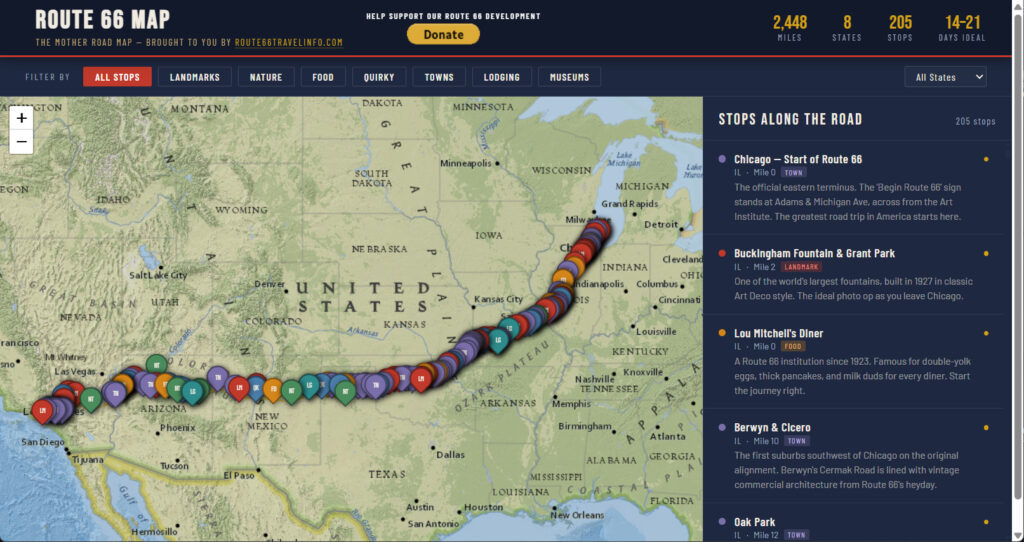
- State highway maps: Print or carry paper maps for each state. The state-by-state travel guides on this site — for Illinois, Missouri, Oklahoma, Texas, New Mexico, Arizona, and California — provide detailed alignment guidance for each state.
Documents: What to Carry and Where to Keep It
Keep a physical document folder in the glove box with: driver’s license copy, vehicle registration, insurance card, AAA or roadside assistance card, health insurance card, emergency contact list, motel reservation printout (full trip), and national park pass. The digital versions of these documents are fine for normal use, but if your phone dies, is lost, or is damaged in the desert heat, the physical copies become essential. Photograph all documents before departure and store the photos in cloud backup.
If traveling with children: carry copies of each child’s birth certificate or passport and have a signed parental consent letter if one parent is traveling without the other. Border proximity (New Mexico and Arizona) and the diversity of law enforcement jurisdictions along the route make these worth having.
Clothing: Pack for Four Climates in One Trip
Route 66 crosses four distinct climate zones in a single trip: the Midwest continental climate of Illinois and Missouri, the Great Plains wind exposure of Kansas and Oklahoma, the desert climate of New Mexico, Arizona, and the California Mojave, and the Mediterranean coastal climate of the Los Angeles basin and Santa Monica. No single clothing configuration handles all four perfectly, which is why layers are the core philosophy for Route 66 packing. A system of base layers, mid-layers, and one versatile shell jacket handles temperature swings from 35°F in Flagstaff to 115°F in Needles without requiring a large wardrobe. Plan for laundry every 5–7 days — laundromats are available in every significant Route 66 town.
Photography Gear: Specific Recommendations for Route 66
Route 66 is one of the most photographed roads in the world, and the specific photography conditions along the route are worth preparing for:
- Dust protection: The high desert sections — particularly the Painted Desert in Arizona and the New Mexico plateau — generate significant dust. Carry lens cloths and a soft brush. Sensor dust is a real issue in these conditions.
- Heat protection for batteries: Camera batteries discharge faster in extreme heat. Carry 2+ spare batteries for each device. Keep the camera in a bag or shade when not in use — direct desert sun heats electronics rapidly.
- Golden hour timing: The best light on Route 66 — the long shadows across the Painted Desert, the neon signs at dusk in Tucumcari, the Santa Monica Pier at sunset — happens in roughly 30–45 minute windows around sunrise and sunset. Plan your arrival at major photo stops accordingly.
- A dash cam: A dashcam mounted to the windshield provides automatic video documentation of the drive — an irreplaceable record of two-lane alignments, passing roadside architecture, and the rare moments when the road is completely empty. The footage becomes a personal documentary of the trip. Highly recommended.
Safety and Emergency Gear: What It Looks Like in Practice
The emergency kit in the master checklist above is not theoretical. Here is what those items look like in a real desert breakdown scenario:
- You get a flat tire on a two-lane section 25 miles from the nearest town. You need: the spare tire, jack, lug wrench, and reflective triangles placed 50–100 feet behind the vehicle. The flashlight is necessary if it happens after dark. The emergency blankets become relevant if the wait is long in extreme heat or cold.
- Your battery dies in a parking lot in Tucumcari at night. You need: jumper cables and either a second vehicle (ask at the motel) or a portable jump starter pack (highly recommended — eliminates the need for another vehicle). The jump starter pays for itself the first time you use it.
- A warning light comes on and you are not sure what it means. You need: the multi-tool, basic tool kit, and your AAA card or roadside assistance app. Do not attempt to diagnose a serious mechanical issue alone in the desert — call for assistance.
Packing & Prep for Special Vehicle Types
RV and Motorhome Travelers
RV travel on Route 66 requires additional preparation beyond the standard vehicle checklist:
- Propane system: Inspect for leaks, test appliances, and carry a propane cylinder gauge. Know the locations of propane fill stations along the route — some rural sections in New Mexico and Arizona have limited options.
- Generator: Test the generator before departure and carry extra engine oil for it. Desert heat puts extra load on RV generators running A/C.
- Water tanks: Fill fresh water tank before entering remote sections. Know the locations of RV water fill stations (many campgrounds and truck stops).
- Low clearance awareness: Several historic Route 66 alignments pass under low railway bridges — particularly in Illinois and Missouri. Know your vehicle’s clearance height.
- Campground reservations: Book KOA and state park campgrounds for the full route before departure. During summer and the Route 66 Centennial year (2026), desirable campgrounds fill weeks in advance.
Motorcycle Riders
Motorcycling Route 66 is a cherished tradition — but the packing and prep considerations are distinctly different:
- Gear: Full protective gear is essential in the desert states — not for temperature comfort but for sun protection and abrasion resistance. A full-face helmet, jacket with armor, and protective pants are non-negotiable in 110°F conditions where a slide on desert pavement at any speed produces severe road rash.
- Hydration: Motorcyclists dehydrate faster than vehicle occupants because of wind exposure. Carry a hydration pack (CamelBak or similar) and drink proactively — thirst is a late indicator of dehydration in extreme heat.
- Tool kit: A dedicated motorcycle emergency kit: tire plug kit, CO2 inflators, chain lube, zip ties, electrical tape, and a compact toolkit appropriate for your specific bike.
- Luggage strategy: Soft saddle bags are more Route 66-appropriate than hard cases for two-lane driving. Pack to keep the center of gravity low and distribute weight evenly.
- Heat strategy: Plan desert sections for early morning riding. The difference between a 7 AM start and a 10 AM start in the Arizona Mojave in July is 25–30°F of ambient temperature.
Seasonal Packing Adjustments
The base packing list and vehicle checklist apply in all seasons. This table covers the additions and modifications specific to each season based on the weather conditions you will encounter across the eight Route 66 states. For a complete breakdown of what each season looks like across the full route, see the article on the Best Time of Year to Drive Route 66.
| Season | Seasonal Packing Additions & Adjustments |
| Spring (Mar–May) | Add: Rain jacket (spring thunderstorms in IL, MO, OK, TX — tornado season April–June). Layers for variable temps (40°F mornings in Illinois, 90°F afternoons in Arizona by May). Allergy medication (high pollen in Midwest spring). Weather app with severe weather alerts — mandatory for Oklahoma and Texas. Check Oklahoma DOT road conditions daily in April–May. |
| Summer (Jun–Aug) | Add: 4+ gallons extra water in vehicle at all times (not optional — it is survival equipment in the Arizona/California desert). Extra cooling system coolant (1 gallon). Cooling towels and a portable battery fan. White or light-colored clothing. Insulated parking sun shade for windshield. Desert driving strategy: before 10 AM and after 5 PM in AZ and CA. Check tire pressure daily (heat expands air). Pack snacks that won’t melt (avoid chocolate, gummies). |
| Fall (Sep–Nov) | Add: Mid-weight fleece or jacket (Flagstaff drops to 35°F by November; Ozarks to 40°F in October). Layers for Midwest fall temperature swings. This is the most forgiving season for packing — the base list handles fall well with the addition of warm layers. Photography equipment gets priority in fall for golden hour landscape shots. |
| Winter (Dec–Feb) | Add (for IL/MO/OK/TX sections): Ice scraper and snow brush. Winter traction mats or recovery boards. Tire chains if crossing mountain passes in NM or AZ. Heavy winter coat, gloves, wool hat, thermal base layers. Warm sleeping bag in trunk (emergency). Kitty litter or sand for traction. For AZ/CA sections only: Standard fall packing applies — western desert winter is mild. Check NMDOT, AZDOT, and Caltrans road conditions daily. |
Preparing for the Route 66 Centennial (2026)
The Route 66 Centennial — November 11, 2026 — will generate record visitation across all eight states throughout the year. A few Centennial-specific preparation notes:
- Book all accommodation before departure — without exception. The Centennial year will see higher demand than any year in the highway’s modern history. Historic motels that normally have walk-in availability will be fully booked weeks in advance. See the Route 66 Centennial 2026 page for the event calendar.
- Carry extra patience. Popular stops — Cadillac Ranch, the Santa Monica Pier, the Painted Desert — will be busier than usual throughout 2026. Build extra time into your itinerary for crowds at iconic stops.
- Carry business cards or contact info. The Centennial year brings together Route 66 travelers from around the world. The connections made at roadside diners and historic motels in 2026 will be memorable. A simple way to share your information matters more in a year when everyone is on the road.
More Route 66 Trip Planning Resources
Route 66 — Complete Travel Guide — The full overview of all 2,448 miles: history, alignments, and what to expect in each state.
Best Time of Year to Drive Route 66 — Season-by-season weather breakdown that directly informs seasonal packing decisions.
How Long Does It Take to Drive Route 66? — The trip length determines how much to pack — one week vs. three weeks requires different clothing and supply quantities.
East to West or West to East? — Direction affects when you hit the desert sections, which changes heat prep priorities.
Budgeting for a Route 66 Road Trip — Fuel costs, lodging tiers, and food planning — the companion article to this packing guide.
Route 66 in Illinois — The first state: urban Chicago start, then small-town corridor to the Missouri line.
Route 66 in Missouri — Ozark two-lane alignments, spring/fall weather variability, and the best diner corridor on the route.
Route 66 in Oklahoma — Tornado Alley: severe weather app is mandatory equipment April through June.
Route 66 in Texas — The Panhandle wind exposure and Cadillac Ranch.
Route 66 in New Mexico — High desert heat, monsoon flash floods (July–Sept), and the longest state mileage on the route.
Route 66 in Arizona — The most demanding driving on the route: extreme heat, mountain grades, and the longest service gaps.
Petrified Forest National Park and the Painted Desert — Carry your America the Beautiful pass and a full water supply before entering.
Route 66 in California — The Mojave is the most water-critical section of the entire route. The Santa Monica Pier is the finish line.
Route 66 Centennial 2026 — The 100th anniversary: events, celebrations, and pre-booking strategy for the biggest Route 66 year ever.
Route 66 State Associations — Local knowledge, membership, and event calendars for all eight states.