Route 66 with Kids: The Complete Family-Friendly Planning Guide
Route 66 was built for the family road trip before the family road trip was even a thing. In its postwar heyday — the 1950s and 1960s when station wagons loaded with kids rolled west toward California every summer — the Mother Road was lined with the exact things that made children happy: giant dinosaur statues, wigwam motels, roadside caves, drive-in root beer stands, spray-paint art installations, and diners with the best pie in America. Most of those things still exist. And in many ways Route 66 is more ready for family travel today than it has been in decades — the preservation movement has restored dozens of iconic stops, new visitor centers and Junior Ranger programs have made the national park sections genuinely enriching for kids, and the Pixar Cars films, which drew explicit inspiration from the Mother Road, have given an entirely new generation of children a reason to know what Route 66 is before they ever drive it.
The honest answer to “Is Route 66 good for families?” is: yes, with planning. The challenges are real — long driving days, desert heat, remote stretches with no services — but every one of them is manageable with the right preparation. And the rewards are extraordinary: a family that drives Route 66 together builds a shared memory that lasts a lifetime. The child who spray-paints a Cadillac in Texas, earns their Junior Ranger badge at the Petrified Forest, sleeps in a concrete teepee in San Bernardino, and sees the Pacific Ocean for the first time from the Santa Monica Pier after 2,000 miles of driving will carry that trip with them forever.
This guide covers everything you need to plan a successful family Route 66 trip: age-by-age planning strategies, the top family-friendly stops on the route, daily mileage guidance by family type, lodging recommendations for families, desert safety with children, car entertainment strategies, budget tips for families, and the specific considerations that make a Route 66 family trip different from a couple’s or solo trip.
Planning by Age: What Works at Every Stage
The single most important family Route 66 planning decision is matching the trip pace to the youngest child in the vehicle. A family with a toddler and a twelve-year-old should plan to the toddler’s limits — a well-paced trip that respects the youngest member’s needs will be infinitely more enjoyable than one that pushes too hard and produces exhausted, overwhelmed children who never want to hear the words ‘Route 66’ again. The table below provides honest guidance for each age group.
| Age Group | Best Sections | Planning Tips for This Age | Top Stops for This Age |
| Infants & Toddlers (0–3 years) | Short segments, western desert & CA sections | Maximum 2–3 hours driving per day. Plan stops every 60–90 minutes. Nap times become driving time — schedule long stretches during expected nap windows. Pack a portable white-noise machine for motel sleep. The western desert sections (AZ, CA) work better than the Midwest for this age because the scenery changes faster and attention spans are irrelevant. | Cadillac Ranch (run and play), Petrified Forest visitor center, Roy’s Motel in Amboy (photo stop), Santa Monica Pier (beach). Keep it visual and physical — walking spaces, not museums. |
| Early Elementary (4–7 years) | Oklahoma, Texas, New Mexico | Introduce the route as a story with a beginning and end — kids this age respond beautifully to the ‘we are driving all the way across America’ narrative. Get them a journal for drawing things they see. The Cars movie connection (Route 66 inspired the film’s setting) is a powerful engagement tool — many stops are explicitly Cars-themed. Maximum 3–4 hours driving per day. | Blue Whale of Catoosa (Oklahoma), Cadillac Ranch (spray paint — kids love it), Wigwam Motel (sleep in a teepee), Meramec Caverns (Missouri), Cozy Dog Drive In (Springfield, IL — birthplace of the corn dog), Standin’ on the Corner in Winslow AZ. |
| Tweens (8–12 years) | All states — optimal age for Route 66 | This is the golden age for a Route 66 family trip. Kids are old enough to understand the history, engaged enough to participate in navigation, and young enough to find the roadside kitsch genuinely exciting. Give them a dedicated role: navigator (with the EZ66 guide or offline maps), photographer, journal keeper, or keeper of the mileage log. Maximum 5–6 hours driving per day with meaningful stops. | Petrified Forest National Park, Cadillac Ranch (spray paint their initials), Meramec Caverns, the National Route 66 Museum in Elk City OK, the Painted Desert, Roy’s Motel and Café in the Mojave, Wigwam Motel, Santa Monica Pier arcade. |
| Teenagers (13–17 years) | Urban sections & Arizona for high-drama scenery | Teenagers on Route 66 are either the best travel companions or the most resistant — engagement is the key variable. Give them genuine ownership: let them choose one stop per state that interests them specifically (their choice respected without negotiation), assign photography duties for the trip record, and make the history genuinely interesting by connecting it to things they already care about (music, cars, film, American history). Maximum 6–7 hours driving per day. | Chicago deep-dish food tour, Cadillac Ranch (spray paint brings out creativity in teenagers), Route 66 neon photography in Tucumcari, the Oatman donkeys, the Painted Desert at sunrise, Santa Monica Pier (earn the finish line). |
Family Daily Mileage Guide: How Far to Drive Each Day
The standard Route 66 daily mileage advice — 150–200 miles per day — is adult-paced advice. Families with children need to adjust these numbers significantly, and the adjustment depends entirely on the age of the youngest child in the vehicle. The most common family Route 66 mistake is planning at adult mileage and then discovering on day three that the trip is unsustainable with a six-year-old in the back seat.
| Family Type | Recommended Daily Miles | Full Route Days | Pacing Notes |
| Infants & Toddlers (0–3) | 80–120 mi/day | 20–30 days | Stop every 60–90 minutes regardless of mileage. Nap windows are the only time you cover real distance. A partial route (New Mexico → California, ~1,200 miles) is the most practical option for this age group. Full route with toddlers is possible but requires extraordinary parental patience and genuine trip flexibility. |
| Early Elementary (4–7) | 100–150 mi/day | 16–24 days | Stop every 2 hours. Plan 2–3 activity stops per day in addition to driving. The Cars movie connection sustains engagement at this age — frame every stop as ‘a place from Cars Country.’ A 14-day trip is possible but 18–21 days is far more enjoyable for everyone. |
| Tweens (8–12) | 150–200 mi/day | 12–16 days | The closest to the adult pace while still needing structured activity stops. Kids this age can handle 5–6 hours in the car if the stops are genuinely interesting. A 14-day full route is realistic and deeply satisfying for this age group. Their engagement makes every stop richer for the whole family. |
| Teenagers (13–17) | 175–225 mi/day | 11–14 days | Teenage travelers can handle adult driving paces if they have genuine stake in the trip (their own camera, their own stop selections, their own journal). A 14-day full route is ideal. The risk at this age is over-driving on teen-driven days and then having nothing in reserve when you hit the best sections. |
| Mixed-age family | 120–160 mi/day | 15–20 days | When the family includes multiple age groups (a toddler AND a tween, for example), plan to the youngest child’s tolerance, not the oldest. A mixed-age family that respects toddler limits will have a better trip than one that tries to push to teenager pace. Build in at least one ‘zero driving’ day per week for everyone to reset. |
FAMILY PACING PRINCIPLE: The best family Route 66 trips are planned around stops, not miles. Instead of ‘we need to cover 150 miles today,’ plan ‘we will hit the Blue Whale of Catoosa, have lunch at a local diner, and make it to Claremore by 4 PM.’ The miles take care of themselves when the days are organized around experiences.
Top Family-Friendly Stops on Route 66
Route 66 has more genuinely great family stops than almost any road trip in America — the combination of interactive roadside art, national parks with Junior Ranger programs, bizarre roadside architecture, and iconic food experiences covers every age group and every interest. The stops below are rated specifically for family and child appeal, not just general Route 66 significance.
| Stop | State | Best Ages | Why It Works for Families |
| Blue Whale of Catoosa, OK | Oklahoma | All ages | A giant smiling blue whale in a pond — built by a man for his wife’s birthday in 1972, now an iconic Route 66 landmark. Kids can swim in the pond (seasonal), climb on the whale, and take one of the most joyful family photos on the entire route. Free admission. Absolutely mandatory family stop. |
| Cadillac Ranch, Amarillo TX | Texas | All ages | Ten Cadillac cars half-buried nose-first in a Texas Panhandle wheat field, covered in spray paint. Visitors are encouraged to add their own paint (bring a can — sold at Walmart in Amarillo). Kids love the physical participation, the scale, and the absurdity. Open 24/7, free. The morning light is best. |
| Wigwam Motel, San Bernardino CA | California | All ages | Sleep in a concrete teepee. Built in 1949, the Wigwam Motel in San Bernardino is one of the most recognizable lodging experiences in America. Each room is a freestanding teepee-shaped structure. For children, this is not accommodation — it is the best night of the trip. Book 3–6 months in advance; it sells out. |
| Meramec Caverns, Stanton MO | Missouri | 4+ years | A vast cavern system on the Missouri Route 66 corridor, promoted for generations on barn-side advertisements painted across the Midwest. Guided tours, dramatic stalactite formations, and a sense of genuine underground discovery. The light show at the end of the standard tour is one of the most memorable moments in Missouri Route 66 travel. Kids 4 and older handle the 1-hour tour well. |
| Cozy Dog Drive In, Springfield IL | Illinois | All ages | The birthplace of the corn dog on a stick — or ‘cozy dog’ as the inventor Ed Waldmire named it. A Route 66 food institution since 1946 in Springfield, Illinois. The Route 66 memorabilia-filled dining room is a genuine piece of history. For kids, eating the food that was invented on Route 66 in the town where it was invented is a perfect teachable moment. |
| Petrified Forest National Park, AZ | Arizona | 5+ years | Ancient trees turned to colorful crystal over 225 million years, lying scattered across a desert landscape that looks like another planet. The Junior Ranger program at the visitor center gives kids a structured experience — they complete activities and earn an official Junior Ranger badge. The badge ceremony at the ranger desk is genuinely moving for children and parents alike. |
| Painted Desert, Arizona | Arizona | All ages | The banded, multi-colored desert badlands of the Painted Desert are accessible from the Petrified Forest park entrance. The overlooks require no hiking and provide immediate, overwhelming visual impact. Very young children respond instinctively to the scale and color. Sunrise and late afternoon light is the most photogenic. |
| National Route 66 Museum, Elk City OK | Oklahoma | 6+ years | The most comprehensive Route 66 museum on the entire route. Full-scale dioramas of Route 66 eras, original vehicles, restored roadside structures, and the kind of immersive presentation that makes history tangible for children. The adjacent Old Town Museum complex adds additional context. Elk City is a logical overnight stop on the Oklahoma corridor. |
| Santa Monica Pier, Santa Monica CA | California | All ages | The End of the Trail. The Santa Monica Pier has a full amusement park (Pacific Park) with rides appropriate for all ages, carnival games, the classic wooden roller coaster, and the Pacific Ocean. For families, arriving at the Santa Monica Pier after 2,000+ miles of driving together is one of the most emotionally resonant moments in American family travel. Make it a full day — celebrate properly. |
| Roy’s Motel & Café, Amboy CA | California | All ages | The most photographed building in the California Mojave — a 1945 motel and gas station on the most remote stretch of Route 66 in California. The neon Roy’s sign against the Mojave sky is iconic. For kids, the dramatic isolation of the Mojave and the time-warp atmosphere of Roy’s is unforgettable. Open for gas and snacks. |
| Blue Swallow Motel, Tucumcari NM | New Mexico | All ages | The most photographed motel on Route 66, with a neon sign that glows magnificently against the New Mexico night sky. For families, arriving at Tucumcari after dark to see the neon strip in full glow is one of the most visually memorable moments of the trip. The motel itself books out months in advance — reserve early and make it a priority overnight. |
| Standin’ on the Corner, Winslow AZ | Arizona | All ages | The Eagles song ‘Take It Easy’ immortalized standing on a corner in Winslow, Arizona, and the city built a park around it — complete with a bronze statue, a flatbed Ford, and a painted wall mural. For families with kids who know the song (introduce them before the trip), this is a perfect photo stop. Free, quick, and deeply satisfying. |
Family Lodging on Route 66: Best Options for Families with Kids
Lodging strategy is one of the most significant differences between a family Route 66 trip and an adult trip. Families need rooms that accommodate multiple people without paying for two hotel rooms, properties with pools (crucial for resetting children’s energy at the end of a driving day), lodging that tolerates the noise and activity level of children, and booking flexibility for the days when the plan changes because a child is sick or the car needs attention. Here is the family lodging strategy that experienced Route 66 families use.
The Iconic Motels: Book These for Your Children, Not Just Yourself
The historic Route 66 motels are not just nostalgia trips for adults — several of them are the single most memorable night a child will have on the entire trip:
- Wigwam Motel, San Bernardino, California — Sleeping in a concrete teepee is the kind of experience that cements a child’s memory of the trip forever. Book as far in advance as possible — it sells out consistently. The San Bernardino location is the original; the Holbrook, Arizona location is also family-friendly.
- Wigwam Motel, Holbrook, Arizona — The Arizona Wigwam is another must-book for families. Located in Holbrook near the Petrified Forest, it makes a natural family night after a day in the park. Book months in advance for summer.
- Blue Swallow Motel, Tucumcari, New Mexico — The neon sign visible from the road at night is one of the most photographed and most beloved images in all of Route 66 travel. For children, arriving in Tucumcari after dark and seeing that glowing turquoise sign is a Route 66 memory that lasts. A smaller property — book 4–6 months ahead for summer stays.
- Munger Moss Motel, Lebanon, Missouri — A beloved Route 66 institution on the Missouri corridor. The owners are among the most knowledgeable Route 66 historians on the route and are exceptionally welcoming to families. A genuinely special overnight.
Chain Hotels: The Family Workhorse
For the majority of nights on a family Route 66 trip — the nights between the iconic properties — extended-stay and suite-format chain hotels are the family traveler’s best friend. Look specifically for:
- Suite rooms or connecting rooms: Hampton Inn, Hilton Garden Inn, Hyatt Place, and Residence Inn all commonly offer suite layouts where parents and children share a room with a dividing space. This preserves adult evening time after children are asleep without paying for two separate rooms.
- Properties with outdoor pools: A pool at the end of a driving day is one of the most effective child-management tools on Route 66. The 30–60 minutes of pool time transforms cranky, restless children into cooperative, happy ones. Filter hotel searches specifically for outdoor pool availability.
- In-room microfridges: For families using the cooler-and-grocery strategy to control food costs, a room with a microwave and refrigerator is a significant convenience. Extended Stay America and Residence Inn properties always have them; other brands offer them on request.
Camping and RV Travel with Kids
Camping along Route 66 is an underrated family option — particularly in the Arizona and New Mexico sections where public lands campgrounds offer spectacular desert scenery at $10–$25 per night. KOA Kampgrounds are available in or near most major Route 66 towns and offer family-specific amenities: playgrounds, pools, and the KOA Kids’ activities program at some locations.
Family camping tips specific to Route 66:
- Reserve summer and Centennial year campgrounds months in advance. The most scenic campgrounds near popular Route 66 stops (Williams, AZ near the Grand Canyon; Albuquerque; Flagstaff) fill early in summer.
- Do not camp in the open desert without preparation. Dispersed camping on BLM land in New Mexico and Arizona is free and spectacular — but the distance from services requires full water and supply preparation. See the packing checklist article for desert camping requirements.
- Flagstaff KOA is one of the best family campgrounds on the route — forest setting, mountain elevation (cooler in summer), proximity to Flagstaff’s excellent downtown, and easy access to the Arizona Route 66 corridor.
Desert Safety with Children: The Non-Negotiables
The Arizona and California desert sections of Route 66 are genuinely dangerous for children who are not properly prepared. Children are significantly more vulnerable to heat illness than adults — their bodies heat up faster, they do not recognize their own dehydration, and they cannot reliably communicate distress until symptoms are serious. Desert safety with children is not a matter of caution for its own sake; it is specific, actionable preparation that prevents emergencies.
Heat Safety: Children Are Not Small Adults
- Children dehydrate faster than adults and do not reliably feel thirsty. Enforce hydration on a schedule — offer water every 30–45 minutes in the desert sections regardless of whether children say they are thirsty. Small, frequent sips are more effective than large volumes at intervals.
- Never leave children in a parked vehicle in desert heat — not for any amount of time. A car interior in the Arizona summer can reach 140°F+ within minutes of parking. This rule has no exceptions.
- Plan desert driving for the morning hours. Departing at 7 AM and completing desert sections by noon keeps the hottest hours (noon–5 PM) for air-conditioned stops, indoor attractions, or pool time at the next motel.
- Know the signs of heat exhaustion in children: excessive fussiness or crying, hot or flushed skin, rapid breathing, lethargy, refusal to drink. If any of these appear, stop immediately, get to air conditioning, and provide cool (not ice cold) water. If symptoms include confusion, loss of consciousness, or seizure, call 911 immediately — this is heat stroke, a medical emergency.
- Sun protection is mandatory, not optional. Sunscreen SPF 50+ applied every 2 hours (more frequently if swimming), wide-brim hats for all children, UV-blocking sunglasses, and sun-protective clothing (UPF-rated shirts for extended outdoor time at stops).
Water Quantity for Families in the Desert
The water requirement for children in desert heat is higher per body weight than for adults. For a family driving the Arizona and California desert sections:
- Minimum total vehicle water: 1 gallon per adult per day + 0.5 gallon per child per day, stored in sealed, sun-resistant containers.
- For a family of 4 (2 adults, 2 children): Carry a minimum of 5 gallons for a desert travel day. This is survival water — separate from the family’s regular drinking supply.
- Electrolytes matter: Children who are sweating in desert heat need electrolyte replacement, not just water. Pack Pedialyte packets, electrolyte tablets, or sports drink powder and add them to water bottles during extended outdoor stops.
Wildlife and Nature Hazards
The desert sections of Route 66 pass through habitat for several species that require awareness, particularly when children are exploring at stops:
- Rattlesnakes: Present throughout the desert sections, particularly in Arizona and New Mexico. Teach children never to reach under rocks, into brush, or into dark spaces. If a snake is spotted, back away calmly. Bites are extremely rare among people who do not handle snakes.
- Scorpions: Common in Arizona and the California Mojave. Shake out shoes before putting them on, check towels and clothing that have been left on the ground or floor, and do not allow children to pick up rocks in desert areas without a stick-tap first.
- Gila monsters: Slow-moving but genuinely venomous lizards found in Arizona and New Mexico. Distinctive orange-and-black beaded skin. Teach children the ‘look but never touch’ rule for all desert wildlife.
- Flash floods: The desert washes (dry riverbeds) of New Mexico and Arizona can fill with rushing water within minutes during monsoon season (July–September) with no local rain — the storm can be 30 miles away. Never allow children to play in or near desert washes during monsoon season.
Keeping Kids Engaged: Car Entertainment and Learning Strategies
The question every Route 66 family planner eventually asks is: how do we keep the kids engaged during the driving hours? The honest answer has two parts. First, the question itself changes completely depending on age — a two-year-old and a twelve-year-old have essentially nothing in common in terms of what constitutes meaningful car entertainment. Second, Route 66 provides more naturally occurring engagement material than virtually any other American road trip — the frequency of genuinely interesting things visible from or just off the road means that screens-only entertainment is both unnecessary and a significant waste of the trip.
The Route 66 Road Trip Journal
Give every child a dedicated road trip journal before departure — a bound blank notebook, a set of colored pencils or markers, and permission to fill it however they want. The journal becomes the trip’s personal documentary: sketches of roadside landmarks, pressed flowers from a rest stop, ticket stubs from the Meramec Caverns tour, a scorecard for the state license plate game, entries written in the voice of a Route 66 explorer. Journals cost $5 each and produce some of the most treasured family artifacts from the trip. At journey’s end, the journals are read aloud at the Santa Monica Pier as a family ritual.
The License Plate Game and Other Route 66 Car Games
- License plate game: Track how many states’ license plates you can spot. Route 66 in summer generates extraordinary variety — travelers from every state and many countries are on the road. Keep a printed US map and mark states as you find them.
- Route 66 bingo: Create custom bingo cards with Route 66 items (neon sign, vintage gas station, cattle, a windmill, a drive-in, a historic shield marker, a roadrunner, a teepee). Free bingo card generators online; print before departure.
- State capital quiz: As you enter each state, see who can name the capital first. With eight states, this is a reliable and educational running game for the whole trip.
- Mileage estimates: Before each driving segment, everyone in the car guesses how long it will take. The winner at each stop gets to choose the next music. Simple, repeatable, and teaches kids basic distance and time reasoning.
- Photography challenges: Give children with smartphones or cameras a daily photography challenge — ‘today find the most interesting door,’ ‘today photograph five things that are red,’ ‘today find the oldest-looking thing.’ End-of-day photo sharing becomes a family ritual.
Route 66 Audio: Podcasts, Audiobooks, and Music
The audio environment of a family Route 66 trip is worth preparing. Specific recommendations:
- The Grapes of Wrath (audiobook): For families with older children and teenagers, John Steinbeck’s Route 66 novel — read aloud as an audiobook in the car — provides a direct connection between the landscape rolling past the windows and the American story the highway carries. Start it when you enter Oklahoma and let it run through Texas and New Mexico.
- Route 66 history podcasts: Several podcasts cover Route 66 history in accessible formats. Search ‘Route 66 podcast’ for current options — many are suitable for older children and create natural conversation about what you are seeing.
- State-specific music playlists: Build a playlist of music connected to each state before departure. Oklahoma (Woody Guthrie, country), Texas (Texas blues, country), New Mexico (traditional Southwestern music), California (the Beach Boys for the final approach to Santa Monica). The Beach Boys’ ‘Fun Fun Fun’ playing as you arrive at the Santa Monica Pier is a family memory-making moment.
- Cars soundtrack and score: For families with younger children, the Pixar Cars soundtrack (including the Route 66 songs) is the perfect on-ramp to the trip’s mythology. Play it entering Oklahoma and let it frame the next several driving days.
Structured Learning Opportunities for Children on Route 66
Route 66 offers exceptional structured learning opportunities that make the trip educationally meaningful without feeling like school:
- National Park Junior Ranger Programs: Both Petrified Forest National Park and (with a detour) the Grand Canyon offer Junior Ranger workbooks that children complete during the visit and then present to a ranger for the official badge ceremony. The badge ceremony — where children take the Junior Ranger oath and receive their badge — is one of the most genuinely moving and memorable moments available to families on Route 66.
- Route 66 geography: Have children track the trip on a physical map, marking each state crossed and each major stop reached. By the time the family arrives in California, children who have maintained the map have an intuitive understanding of American geography that no classroom can replicate.
- Route 66 history: The National Route 66 Museum in Elk City, Oklahoma is the best single resource for making Route 66 history tangible for children. Allow 2–3 hours and go through it at the child’s pace.
- Regional food education: At every iconic food stop, explain what makes it local — the green chile in New Mexico, the BBQ in Oklahoma, the corn dog birthplace in Springfield, the fry bread on Navajo land in Arizona. Food as a learning tool on Route 66 is underrated and universally effective with children.
Family Budget Tips for Route 66
Traveling Route 66 as a family adds significant costs compared to adult travel — larger rooms, more food, more activity admissions — but also opens specific money-saving strategies that solo and couple travelers do not have access to. The goal for a family budget is to spend on the experiences that produce genuine memories (the iconic motels, the national park admissions, the legendary food stops) and save aggressively on everything else.
Where Family Budgets Diverge from Adult Budgets
- Lodging: Two adults can share a standard hotel room. Families often need a suite, connecting rooms, or a larger space — adding $40–$80 per night over a standard room rate. On a 14-day trip, this adds $560–$1,120 to the lodging budget.
- Food: Children’s menus at restaurants offset some cost, but snacks between meals are a significant family travel expense that adult travelers do not incur. Budget $10–$20 per day in family snack costs above the per-meal food estimate.
- Activities and admissions: Child admission fees at museums, caverns, and attractions add up. The National Park America the Beautiful pass ($80) covers the entire family (up to four adults; children under 15 are always free at national parks) and pays for itself at the Grand Canyon alone.
- Laundry: Families go through clothing faster than adults, and laundromat stops (every 5–7 days) add 2–3 hours and $15–$25 per session. Budget for 2–4 laundry stops on a 14-day trip.
Family Budget Strategies
- The cooler strategy: A well-stocked insulated cooler with breakfast foods, lunch items, and snacks eliminates 1–2 paid meals per day. On a 14-day trip with a family of four, preparing 2 cooler meals per day rather than eating out saves $800–$1,400 over the course of the trip.
- America the Beautiful Annual Pass: $80 covers the whole family at Petrified Forest, the Grand Canyon (if you detour), and any other national sites on or near Route 66. With the Grand Canyon, it pays for itself immediately.
- Free iconic stops: Many of the best family stops on Route 66 are free: Cadillac Ranch, the Blue Whale of Catoosa (swimming is free), the Chain of Rocks Bridge (pedestrians and cyclists), the Standin’ on the Corner park in Winslow, and most roadside architecture. The free stops are often the most memorable.
- Choose motels with pools: A pool eliminates the need for paid activity stops on rest days. The pool hour at the Hampton Inn in Amarillo is the same price as the pool hour at the Wigwam Motel — find properties where the pool comes with the room rate.
- Book historic motel nights in advance: The Wigwam and Blue Swallow at their regular rates are significantly less expensive than the last-minute options available when those properties are fully booked. Early booking at historic motels saves money and secures the rooms children will remember.
The Pixar Cars Connection: Using the Films to Engage Children
Pixar’s Cars (2006) and its sequels drew explicit inspiration from Route 66 — the fictional town of Radiator Springs is based on several real Route 66 towns, most notably Seligman, Arizona (where the late Angel Delgadillo inspired the character Ramone and the town’s preservation story) and Tucumcari, New Mexico. For families with children who know the films, the connection between the movie and the real road is one of the most powerful engagement tools available on a Route 66 trip.
Cars connection stops and moments to plan for:
- Seligman, Arizona: The most directly Cars-connected town on the real Route 66. The Snow Cap Drive-In (Delgadillo’s) is real and unchanged. The town has fully embraced the Cars connection — look for the characters in murals and storefronts throughout. Tell children this is the real Radiator Springs before you arrive.
- Tucumcari, New Mexico: The neon motel strip inspired the look of Radiator Springs at night. Arriving after dark and seeing the Blue Swallow sign glowing against the New Mexico sky is the real-life version of the Radiator Springs neon restoration scene.
- The Painted Desert, Arizona: The opening sequences of Cars show landscapes that are directly based on the Painted Desert. For children who know the film, recognizing those landscapes in real life through the car window is a moment of genuine wonder.
- Wigwam Motel, Holbrook, Arizona: The Cozy Cone Motel in Cars is based in part on the Wigwam Motel’s teepee structures. Staying there after making this connection is unforgettable for Cars-age children.
- Watch Cars together before the trip — and watch it again at the end. The second viewing, after driving the real road, produces a completely different experience for children. The highway that was a movie setting becomes a road they personally drove.
The Route 66 Centennial in 2026: A Once-in-a-Lifetime Family Trip
The Route 66 Centennial — the 100th anniversary of the highway’s commissioning on November 11, 2026 — represents a once-in-a-lifetime family travel opportunity. Children who drive Route 66 in the Centennial year will be able to say, for the rest of their lives, that they were part of the 100th anniversary of one of the most iconic roads in the world. The events, celebrations, and energy of 2026 will make the trip richer in ways that are genuinely historic.
For families planning a Centennial trip:
- Book accommodation for the entire route before January 2026. The Centennial year will produce the highest Route 66 demand in the highway’s modern history. Iconic family properties — the Wigwam in both locations, the Blue Swallow, the Munger Moss — will be fully booked for summer and fall months far in advance.
- Centennial events are family-friendly by design. Car shows, parades, community celebrations, and historical commemorations are being planned across all eight states — most with programming specifically designed for families with children.
- The November 11, 2026 anniversary date is a natural anchor for a fall family trip. A departure from Chicago in mid-October, arriving in Santa Monica in early November, positions the family to be on the road during the most concentrated period of Centennial celebrations.
See the Route 66 Centennial 2026 page for the full, up-to-date Centennial event calendar as it develops.
More Route 66 Trip Planning Resources
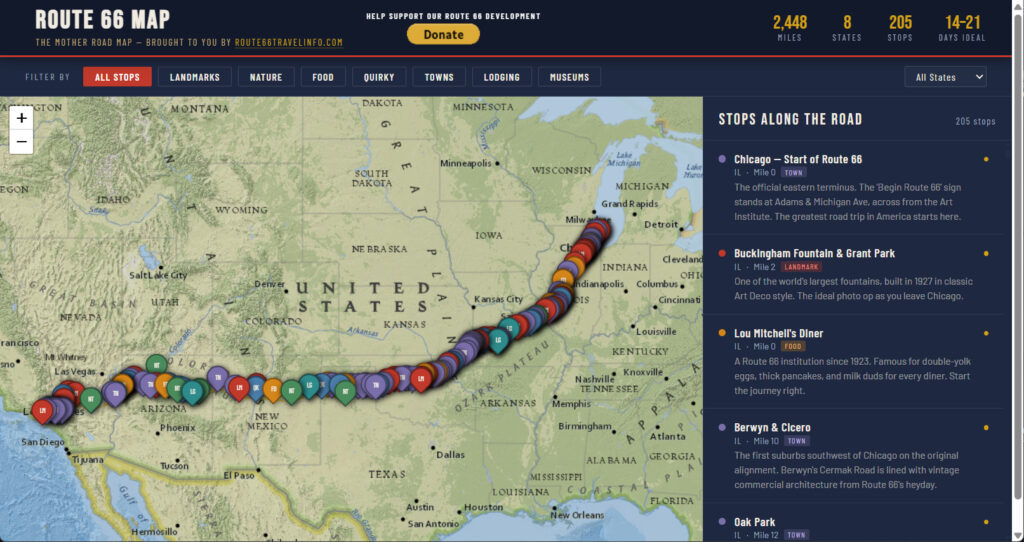
Route 66 — Complete Travel Guide — The full overview of all 2,448 miles: history, alignments, and what to expect in every state.
Best Time of Year to Drive Route 66 — Season-by-season weather guide — critical for families planning desert sections with children. Spring and fall are strongly preferred for families over summer heat.
How Long Does It Take to Drive Route 66? — Family daily mileage is significantly lower than the adult standard — this guide explains the partial-route options that work well for families with young children.
East to West or West to East? — For most families, east to west is strongly recommended — the Santa Monica Pier finish is the perfect payoff for children who have driven the whole route.
Budgeting for a Route 66 Road Trip — Family budget additions to the standard cost estimates — suite rooms, activity admissions, laundry, and the America the Beautiful pass.
Route 66 Packing List & Vehicle Prep Checklist — Family additions to the standard packing list: sunscreen, hydration packs, children’s medications, car entertainment supplies, and the Junior Ranger program workbooks.
Navigating Route 66 — Tween and teen travelers can take on the navigator role — the navigation guide gives them the tools they need.
Route 66 in Illinois — Springfield’s Lincoln sites and the Cozy Dog Drive In — the birthplace of the corn dog — are excellent family stops.
Route 66 in Missouri — Meramec Caverns is one of the best family attractions on the entire route. The Munger Moss Motel is the premier family overnight in Missouri.
Route 66 in Kansas — A quick 13-mile state with the Cars on the Route museum in Galena — perfect for Cars-age children.
Route 66 in Oklahoma — The Blue Whale of Catoosa is one of the greatest free family stops in American road travel. The National Route 66 Museum in Elk City is the best single Route 66 museum for children.
Route 66 in Texas — Cadillac Ranch spray-painting is the participatory art experience that every child remembers. The Midpoint Café in Adrian is a perfect family lunch stop.
Route 66 in New Mexico — The Tucumcari neon strip at night is a family memory. The Blue Swallow Motel is a must-book. Highest dead-zone risk — download offline maps before entering New Mexico.
Route 66 in Arizona — The Petrified Forest Junior Ranger program, the Wigwam Motel, Seligman’s Cars connection, and the Oatman donkeys. The richest single state for family experiences on the entire route.
Petrified Forest National Park and the Painted Desert — The Junior Ranger badge ceremony here is one of the most memorable moments available to families on Route 66.
Route 66 in California — Roy’s Motel and the Mojave, the Wigwam in San Bernardino, and the Santa Monica Pier finish. Carry maximum water for the Mojave section with children.
Route 66 Centennial 2026 — The 100th anniversary on November 11, 2026 — a once-in-a-lifetime family travel opportunity.
Route 66 State Associations — The eight state associations can recommend family-specific events and activities not listed in general travel guides.