How to Experience Route 66 in Illinois: The Complete Guide to the Mother Road’s First State
There is no better place to begin a Route 66 road trip than at the beginning — and the beginning is Illinois. For 301 miles, from the corner of Adams Street and Michigan Avenue in downtown Chicago to the Chain of Rocks Bridge spanning the Mississippi River into Missouri, Illinois lays out the full vocabulary of the Mother Road: small-town diners that haven’t changed in 70 years, towering fiberglass roadside giants, art deco motels with original neon, prairie highways stretching to the horizon, and museums dedicated entirely to the road itself. This is where Route 66 starts, and few states deliver the experience as completely as the Land of Lincoln.

Complete route 66 road trip planner - 45 Pages

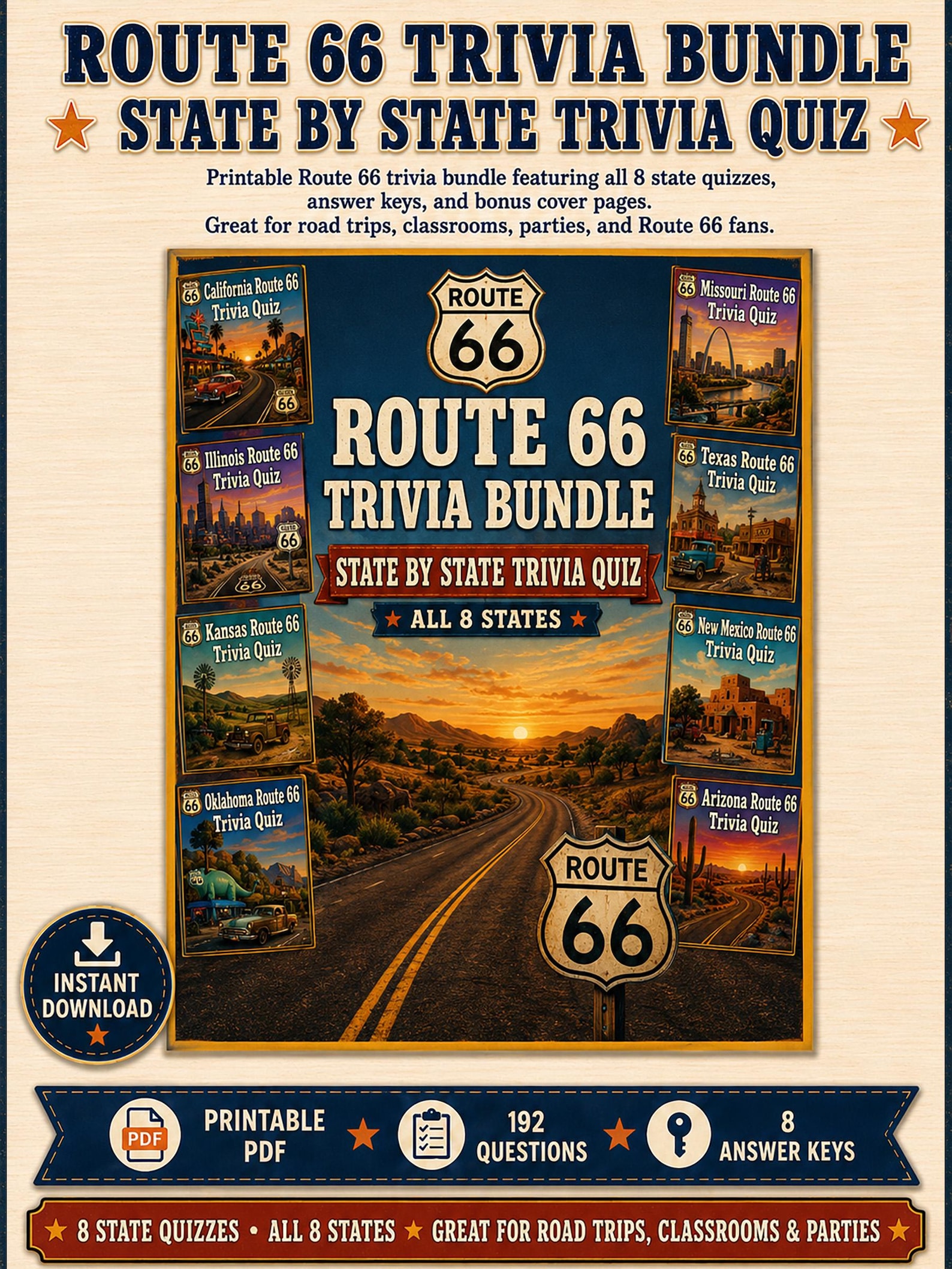
Plan the ultimate Mother Road adventure with this printable Route 66 Road Trip Planner! This vintage-style travel planner is designed to help you organize, track, and remember your Route 66 journey from Chicago, Illinois to Santa Monica, California.
ORDER NOW on ETSY - Instant download
Whether you are planning a full Route 66 road trip, a partial state-by-state drive, a family vacation, a retirement road trip, an RV adventure, or a bucket list USA travel experience, this printable planner gives you the pages you need to plan your route, track your budget, organize overnight stops, log fuel, and journal your memories along the way.

Designed with a retro Americana look, vintage Route 66 shield accents, red ribbon banners, teal borders, gold stars, and classic roadside travel styling, this planner is both useful and fun to print, organize, and take on the road.
ORDER NOW on ETSY - Instant download
Illinois was not just the starting point of Route 66 — it was one of the road’s most active and best-documented corridors during the highway’s golden era. Towns like Joliet, Pontiac, Springfield, and Litchfield became mid-century legends for travelers heading west. Today, they are among the most rewarding stops on any Route 66 itinerary, their historic cores intact and their Route 66 identity proudly celebrated. Whether you have a single afternoon or a full week, driving Route 66 in Illinois rewards at every scale.
This guide covers the full Illinois corridor from north to south: the key stops, the essential diners and landmarks, what to know before you go, how to pace a Route 66 Illinois road trip, and links to the detailed destination guides already on route66travelinfo.com for every major stop along the way.
Illinois Route 66 at a Glance
| Illinois Route 66 — Quick Reference | |
| Total Distance | 301 miles (Chicago to Chain of Rocks Bridge) |
| Starting Point | Adams Street & Michigan Avenue, Chicago |
| Ending Point | Chain of Rocks Bridge, Madison, IL (Mississippi River) |
| Drive Time (Non-stop) | 4.5–5 hours; allow 2–4 days to stop properly |
| Best Season | May–October; spring and fall offer ideal temperatures |
| Major Towns | Chicago, Joliet, Wilmington, Dwight, Pontiac, Bloomington-Normal, Springfield, Litchfield, Edwardsville |
| Don’t Miss | Gemini Giant, Route 66 Hall of Fame (Pontiac), Cozy Dog Drive-In, Ariston Café, Chain of Rocks Bridge |
Map of Route 66 in Illinois
Towns Located on Route 66 in Illinois
List of Route 66 Towns in Illinois from east to west
The Route 66 Starting Point: Chicago
Every eastbound traveler on Route 66 begins at the corner of Adams Street and Michigan Avenue in downtown Chicago, where a historic shield marker commemorates the official start of the Mother Road. The city is, emphatically, not just a place to pass through — Chicago is a full-day destination in its own right before you ever leave Cook County.
The original 1926 alignment followed a sequence of city streets south through Chicago’s neighborhoods before heading southwest through the suburbs. Today’s Route 66 travelers typically begin with a photo at the Adams Street sign, then work their way through the historic corridor via Jackson Boulevard, Joliet Road, and eventually US-66 south. In March 2026, as part of the Route 66 Centennial, Navy Pier was designated as a new ceremonial starting point, offering more open space and photo opportunities for centennial-year visitors.
Key Chicago-area Route 66 stops include the Illinois Institute of Technology corridor, the Lou Mitchell’s Restaurant on Jackson Boulevard (a Route 66 institution since 1923 and the classic first-stop diner for westbound road trippers), and the historic commercial districts of Berwyn and Cicero as you leave the city proper.
Berwyn
Berwyn: Berwyn’s top Route 66 stop is the mini Spindle at Paisans Pizzeria on Ogden Avenue — a 23-foot tribute sculpture of fiberglass go-kart bodies impaled on a spike, honoring the beloved 1989 original that stood at Cermak Plaza until it was demolished in 2008 to make way for a Walgreens.
Cicero
Cicero: Henry’s Drive-In at 6031 W. Ogden Avenue is Cicero’s quintessential Route 66 stop, a classic fast-food stand that has been serving Chicago-style hot dogs since 1950 and is instantly recognizable by its towering neon sign depicting a hot dog piled with mustard and french fries. The Cindy Lyn Motel on Ogden Avenue, open since 1960, is another surviving piece of Route 66-era lodging in Cicero, once billed as the last motel before Chicago, and the remnant water tower from the massive Hawthorne Works factory — which once employed 40,000 people — is visible from the Route 66 corridor.
Oak Park
Oak Park: Route 66 travelers passing through Oak Park are greeted by two of America’s greatest cultural landmarks: the Frank Lloyd Wright Home and Studio, where Wright developed the Prairie style architecture that transformed American design, and the birthplace and childhood home of author Ernest Hemingway. The Frank Lloyd Wright Historic District contains the world’s greatest concentration of Wright-designed buildings, explorable on guided or self-guided walking tours, and Unity Temple on Lake Street — a UNESCO World Heritage Site — remains one of Wright’s finest surviving public buildings.
Burr Ridge
Burr Ridge: Harvester Park in Burr Ridge features a one-of-a-kind Route 66-themed playground that replicates real roadside attractions found along the historic highway — including a 30-foot-tall Chicago skyscraper with tube slides, Wigwam Village climbers, and Cadillac Ranch benches — sitting just steps from the original Route 66 alignment. The original Route 66 path here, which takes travelers north of I-55 on a two-lane frontage road, passes several historic sites including Cass Cemetery, the former Martin B. Madden mansion known as Castle Eden, and the former International Harvester experimental fields that gave Burr Ridge its old name of “Harvester, Illinois.”
Joliet
Joliet: Joliet is a major Route 66 destination anchored by the Joliet Area Historical Museum and Route 66 Welcome Center, the spectacular 1926 Rialto Square Theatre (known as the “Jewel of Joliet”), and the iconic Old Joliet Prison on Collins Street. The Rich & Creamy ice cream stand on Broadway, with its rooftop statues of the Blues Brothers dancing beside a giant ice cream cone, is one of the most photographed stops in town, and the site of the world’s first Dairy Queen at 501 N. Chicago Street — opened in 1940 — is marked with a local landmark plaque.
Elwood
Elwood: Elwood is home to two remarkable legacies of the former WWII Joliet Army Ammunition Plant: the Midewin National Tallgrass Prairie, now the largest native prairie restoration in the eastern United States where bison roam freely, and the Abraham Lincoln National Cemetery, one of the country’s largest veterans’ cemeteries. A roadside monument at the curve of the original Route 66 alignment features a Rosie the Riveter silhouette and a Route 66 wayside exhibit, commemorating the women workers and wartime history of the arsenal — the site of the deadliest munitions plant accident in the US during World War II.
Wilmington and the Gemini Giant: Illinois’s Most Iconic Roadside Stop
About 60 miles southwest of Chicago, travelers enter Wilmington, Illinois — home to one of the most photographed figures on the entire 2,448-mile length of Route 66. The Gemini Giant is a 28-foot fiberglass spaceman in a silver suit and astronaut helmet, clutching a gleaming rocket, standing sentinel at the entrance to town. He is a surviving example of the fiberglass Muffler Man giants produced in the 1960s by International Fiberglass of California, customized here with a space program theme during the era of the Gemini missions.
The Giant was sold at auction in March 2024 and purchased by the Joliet Area Historical Museum, which loaned him to the City of Wilmington for permanent display at South Island Park, 201 Bridge Street. He is free to visit, endlessly photogenic, and an essential first major stop on any Illinois Route 66 road trip. Read the full Wilmington, Illinois Route 66 travel guide for everything to see and do in town, including the scenic Kankakee River setting.
Braidwood
Braidwood: The Polk-A-Dot Drive-In is Braidwood’s beloved Route 66 institution, operating since 1956 in a polka-dotted building surrounded by life-sized fiberglass figures of Elvis Presley, Marilyn Monroe, Betty Boop, James Dean, and the Blues Brothers, with a Wurlitzer jukebox playing 45s inside. The Braidwood area is also world-famous among paleontologists for its fossil beds, with specimens on display at the Chicago Field Museum and the Smithsonian, and the Mazonia-Braidwood State Fish and Wildlife Area is open for fossil hunting with a permit.
Coal City
Coal City: Coal City sits near the original 1926 Route 66 alignment along IL-53, which traces the heart of the old Illinois coal country between Wilmington and Gardner — a corridor defined by immigrant mining communities whose story shaped this corner of the state. The nearby Mazonia-Braidwood Fish & Wildlife Area, a reclaimed strip mine, is an exceptional spot for wildlife viewing and fossil hunting, while the short drive south to Braidwood’s Polk-A-Dot Drive-In makes Coal City a convenient base for exploring this richly historic stretch of the Mother Road.
Gardner
Gardner: Gardner’s most famous Route 66 curiosity is the two-cell jail — a tiny wood-framed lockup built in 1906 that has been preserved along the old alignment, where visitors can step inside, take a photo behind bars, and listen to an audio message about small-town law enforcement in the early 20th century. Also in Gardner is the Historic Streetcar Diner, a Kankakee horse-drawn streetcar that arrived in town in 1932 to serve as a diner for Route 66 travelers, making it one of the more unusual roadside dining histories on the Illinois Mother Road.
Dwight
Dwight: Dwight’s signature stop is the Ambler-Becker Texaco Station, built in 1933 and now on the National Register of Historic Places — it operated for 66 years, making it the longest-running service station on all of Route 66, and today serves as a visitor center where travelers can hear Phil Becker describe life running the station. Nearby, the 1891 Dwight Depot houses the Dwight Historical Society Museum, and the grounds of the former Keeley Institute feature a picturesque five-story 1896 windmill — the institute itself was once internationally famous for its alcoholism cure and drew patients from around the world.
Odell
Odell: Odell’s showpiece is the beautifully restored 1932 Standard Oil Filling Station, one of the finest surviving examples of a vintage Route 66 service station in Illinois — it pumped gas from 1932 to 1967, served travelers until 1975, and is now a free visitor stop with an audio program telling the station’s story. Just outside of town, the Odell “Subway” Tunnel is a 1937 underpass built beneath busy Route 66 so schoolchildren could cross safely — a fascinating piece of highway infrastructure history that few travelers know to look for.
Pontiac, Illinois: The Heart of Route 66 on the Mother Road
No stop in Illinois is more completely devoted to Route 66 than Pontiac — a charming county seat about 100 miles southwest of Chicago that has transformed itself into one of the most rewarding museum towns on the entire corridor. The centerpiece is the Route 66 Association of Illinois Hall of Fame and Museum at 110 West Howard Street, housed in a beautifully restored 1891 Romanesque Revival firehouse listed on the National Register of Historic Places.
The museum is free to enter and staffed by passionate volunteers who are genuine Route 66 experts. Its collections span thousands of artifacts, photographs, and memorabilia items tracing the full 301-mile Illinois corridor. The Bob Waldmire Experience — honoring the legendary Route 66 artist and preservationist — is one of the museum’s highlights, as is the massive Route 66 Shield Mural on the building’s exterior wall, one of the most photographed spots on the Illinois corridor.
Pontiac’s downtown also houses the Pontiac-Oakland Automobile Museum at 205 North Mill Street — the only museum in the world dedicated exclusively to Pontiac and Oakland automobiles, covering everything from the brand’s 1890s horse-drawn buggy ancestry to the 1960s GTO that launched the American muscle car era. Together these two museums make Pontiac one of the most rewarding half-day stops on the entire Illinois Route 66 corridor. For even more to see in town, read the full Route 66 landmarks in Pontiac guide.
Pontiac Visitor Quick Facts
| Route 66 Hall of Fame | 110 W. Howard St. | Free | Daily 9 AM–5 PM |
| Pontiac-Oakland Auto Museum | 205 N. Mill St. | Free | Daily 10 AM–4 PM |
| Murals | 20+ Walldog murals throughout downtown |
| Location | ~100 miles SW of Chicago, just off I-55 at Exit 197 |
Bloomington-Normal and Towanda: Stretching the Road
Between Pontiac and Springfield, the corridor passes through Bloomington-Normal — a twin-city hub with its own Route 66 heritage — and the small village of Towanda, one of the most distinctive and quietly compelling stops on the Illinois route.
Towanda’s most remarkable feature is the Route 66 Parkway Trail, a beautifully maintained 2.5-mile walking and biking path that runs alongside the abandoned lanes of the original 1926–1945 alignment. Along the trail, a community-created series of painted maps and interpretive signs highlights each of the eight states traversed by Route 66. It is one of the most educational and visually engaging outdoor experiences on the Illinois corridor — and it’s entirely free.
Lexington
Lexington: Lexington’s standout Route 66 attraction is Memory Lane — a restored one-mile stretch of original Route 66 pavement turned into an interpretive trail, complete with vintage Burma Shave signs, Nehi billboards, and other period advertising that recreates the roadside experience of the 1930s and ’40s. The historic downtown also features a classic neon arrow sign known as Thrift Avenue, and Kelly’s on 66 offers a welcoming stop for food and conversation in a town that wears its Route 66 heritage with genuine small-town pride.
Atlanta
Atlanta: Atlanta’s most eye-catching attraction is the 19-foot Muffler Man holding a hot dog — originally installed outside Bunyon’s hot dog stand in Cicero in 1966, it was relocated here when that business closed and now stands watch on the main street as one of Route 66’s most beloved roadside giants. The restored Palms Grill Café is a classic 1930s diner back in operation, the J.W. Hawes Wooden Grain Elevator houses a local museum, and the Atlanta Route 66 Park and the town’s clock tower library round out a surprisingly full stop for such a small community.
Lincoln
Lincoln: Lincoln is the only city in America named for Abraham Lincoln before he became president, and its Route 66 corridor carries that legacy with the Railsplitter Covered Wagon — certified by Guinness as the world’s largest covered wagon — and the Cruisin’ with Lincoln on 66 visitors center dedicated to both Lincoln history and the Mother Road. The Postville Courthouse State Historic Site reconstructs the courthouse where young Lincoln practiced law as a circuit-riding attorney, and the downtown stretch of Business 55 retains classic Route 66-era motels, signage, and commercial buildings that make it one of central Illinois’s most rewarding drives.
Springfield: Route 66’s Capital City Stop
At roughly the midpoint of the Illinois corridor, Springfield is the most layered and historically rich stop in the state — a city where Route 66 nostalgia and the legacy of Abraham Lincoln overlap in a way that exists nowhere else in America. The Illinois state capital is full of Route 66 landmarks that have been operating continuously since the highway’s mid-century golden era.
The crown jewel is the Cozy Dog Drive-In on South 6th Street — the original home of the corn dog on a stick, founded by Ed Waldmire in 1946 and still run by the Waldmire family today. The Cozy Dog is not just a diner; it’s a Route 66 pilgrimage site, its walls covered in Bob Waldmire’s beloved Route 66 artwork, its menu unchanged from the era when travelers heading to California would stop here for a Cozy Dog and a root beer.
Springfield’s Route 66 corridor runs through the Peoria Road alignment to the north and South 6th Street through downtown — a stretch that still features original neon motel signs, vintage service stations, and the urban fabric of mid-century American road travel. The Lincoln sites (Lincoln’s Home, the Lincoln Presidential Museum, the Old State Capitol) complement the Route 66 experience with a historical layer that makes Springfield a genuinely full-day destination. Read the complete Springfield, Illinois Route 66 travel guide for a full breakdown of attractions, restaurants, and visiting tips.
Springfield Route 66 Must-See Stops
| Cozy Dog Drive-In | 2935 S. 6th St. | Open Mon–Sat 8 AM–8 PM | Birthplace of the corn dog on a stick |
| Lauterbach Tire Muffler Man | 3400 S. 6th St. | Free photo stop | Original fiberglass figure |
| Route 66 Motor Court | South 6th St. corridor | Classic 1950s motor court neon |
| Abraham Lincoln Sites | Lincoln’s Home, Lincoln Presidential Library, Old State Capitol |
| Best Season | Late spring or fall; summer is warm and humid but full of events |
Carlinville
Carlinville: Carlinville’s Route 66 highlights include the jaw-dropping “Million Dollar” Macoupin County Courthouse — a project that ballooned from a $50,000 budget to over $1.3 million in the 1870s and took 40 years to pay off — and the Old Macoupin County “Cannonball” Jail, an 1869 fortress allegedly built with Civil War cannonballs embedded in its walls to prevent escapes. Carlinville also holds the world’s largest collection of Sears catalog homes — 152 of the original 156 mail-order houses built in 1917 for Standard Oil mine workers are still standing — giving the residential neighborhoods a character found nowhere else on Route 66
Litchfield and the Ariston Café: One of the Oldest Restaurants on Route 66
South of Springfield, the Illinois corridor passes through Carlinville and into Litchfield — home to one of the most celebrated and historically significant eating establishments on the entire Mother Road. The Ariston Café has been in continuous operation since Pete Adam first opened it in Carlinville in 1924, later relocating to Litchfield in 1929 as Route 66 shifted alignment. It is one of the oldest continuously operating restaurants on the route, inducted into the Route 66 Association of Illinois Hall of Fame in 2006.
The Ariston serves generous, home-style Midwestern meals in a setting that has kept the spirit of its roadside origins intact: vintage photographs, Route 66 memorabilia, and a warm, unpretentious atmosphere that reminds every visitor why roadside diners became the social backbone of American road travel. For any traveler serious about the Illinois Route 66 experience, a meal at the Ariston is not optional.
Also worth a stop near Litchfield: the Skyview Drive-In Theater, one of the few remaining drive-in movie theaters on the Illinois corridor, still operating seasonally and drawing both locals and Route 66 travelers for a mid-century experience that is increasingly rare.
Gillespie
Gillespie: Gillespie sits on the original 1926 Route 66 alignment and is home to the Illinois Coal Museum, which tells the story of the coal-mining industry that once brought thousands of European immigrants to this part of Macoupin County and made Gillespie one of the busiest towns in the region. The town also commemorates a pivotal moment in American labor history: in 1932, 274 disaffected miners met in Gillespie’s Colonial Theater to break away from the United Mine Workers and found the Progressive Miners of America union, an event marked by a historical sign on the site.
Staunton
Staunton: Staunton’s most beloved Route 66 stop is Henry’s Ra66it Ranch — a wonderfully eccentric roadside attraction featuring a menagerie of live rabbits, vintage Route 66 memorabilia, and old VW buses, run by the enthusiastic Henry Weiss, who welcomes travelers with open arms and endless stories. Country Classic Cars in Staunton, where visitors can drive through a massive Route 66 shield, and the DeCamp Junction area with its surviving roadside commercial buildings round out a stretch of the old highway that retains genuine southwestern Illinois flavor.
Collinsville
Collinsville: Collinsville has two very different but equally memorable Route 66 attractions: the 1907 Brooks Catsup Bottle water tower — a 170-foot ketchup-bottle-shaped steel tank that is one of the most beloved roadside oddities on the entire Mother Road — and Cahokia Mounds, a UNESCO World Heritage Site where the most sophisticated pre-Columbian city north of Mexico once stood. The Cahokia Mounds Interpretive Center lets visitors climb the largest earthen mound in North America and learn about a civilization that, at its peak around 1100 AD, rivaled the size of medieval London — an extraordinary pairing with Route 66 kitsch at its finest.
Edwardsville
Edwardsville: Edwardsville’s Route 66 centerpiece is the newly renovated West End Service Station, a restored historic filling station now operating as a visitor center and museum filled with Route 66 memorabilia and photos, anchored by a Route 66 Monument Shield just outside. The 1909 Wildey Theatre in the historic downtown still hosts live performances and stands as a beautifully preserved piece of early 20th-century architecture, while the Carnegie Library’s 16-foot Madison County Centennial Monument and the charming walkable downtown make Edwardsville one of the most complete Route 66 stops in southwestern Illinois.
Madison
Madison: Madison’s most dramatic Route 66 attraction is the Old Chain of Rocks Bridge — built in 1929 as a toll crossing over the Mississippi River, closed to motor traffic in 1968, and reborn as what is now the world’s longest pedestrian and cycling bridge, featuring a distinctive 22-degree bend at its midpoint over the river. Nearby in Mitchell, the Luna Café — built in 1924 and steeped in Prohibition-era legend — is a must-see stop, its vintage neon martini-glass sign beckoning travelers to step into a bar whose walls are lined with Al Capone memorabilia and whose colorful rumored history includes a basement gambling den and upstairs “entertainment.”
The Chain of Rocks Bridge: Illinois’s Grand Finale
Illinois’s Route 66 ends — or begins, depending on your direction — at the Chain of Rocks Bridge over the Mississippi River, one of the most distinctive structures on the entire corridor. The bridge’s most famous feature is its 22-degree bend in the middle — an engineering solution to the geological reality of the river’s rock shelf at that crossing point. Built in 1929 and spanning nearly a mile, the Chain of Rocks Bridge carried Route 66 traffic between Illinois and Missouri for decades before being bypassed in 1966.
The bridge is now closed to vehicle traffic but open to pedestrians and cyclists, offering one of the most dramatic walking experiences on the entire Route 66 corridor. The view from the bend in the middle — looking upstream and downstream at the broad Mississippi — is one of the great panoramic moments of any Illinois road trip. The eastern end of the bridge is on Chouteau Island in Madison, Illinois; the western end is on the Missouri shore north of St. Louis.
Other Notable Illinois Route 66 Stops
The 301-mile Illinois corridor contains dozens of stops worth a slow-down or a pull-off. The highlights below round out any Illinois itinerary.
Dwight
The Ambler-Becker Texaco Station in Dwight is one of the most photographed vintage service stations on the Illinois corridor — a beautifully restored 1930s Standard Oil station that is now the Dwight Route 66 Welcome Center. The town also preserves the original Route 66 bank building and features clear historic alignment markers for self-guided exploration.
Atlanta, Illinois
The small town of Atlanta is home to the Paul Bunyan Hot Dog Statue — a 19-foot fiberglass figure of the legendary lumberjack, repurposed here to hold a giant hot dog. It is a classic Muffler Man variant and one of the most cheerfully absurd roadside figures in Illinois. Atlanta is also home to the small but well-curated Palms Grill Café, a restored 1934 diner that is one of the most authentic period diners remaining on the Illinois route.
Lincoln, Illinois
Lincoln claims the distinction of being the only city in the United States named for Abraham Lincoln before he became president. The World’s Largest Covered Wagon — a 24-foot wagon with a 40-foot wooden wagon tongue — is the town’s most visible Route 66 landmark and a reliable roadside photo stop.
Odell and the Standard Oil Station
The Odell Standard Oil Gas Station (c. 1932) is one of the most pristine and photogenic vintage service stations remaining on the Illinois corridor. It was fully restored in 1999 and recognized by the National Register of Historic Places. It is now a visitor center and free stop — one of those quiet, photogenic moments that makes an Illinois road trip memorable even when no museum is nearby.
Staunton and Henry’s Ra66it Ranch
Henry’s Ra66it Ranch in Staunton is a junk-art folk installation and Route 66 attraction where vintage vehicles, colorful statues, and eccentric roadside humor combine into a genuinely entertaining free stop. It epitomizes the self-made roadside spirit that Route 66 has always nurtured.
Collinsville and the World’s Largest Catsup Bottle
Just off the Route 66 alignment near Collinsville stands the Brooks Old Original Catsup Bottle Water Tower — a 170-foot water tower shaped exactly like a giant bottle of ketchup, built in 1949 and now a nationally recognized folk art landmark. It is free to view from the road and one of the most good-naturedly absurd roadside monuments in the entire Midwest.
How to Drive Route 66 in Illinois: Pacing and Planning
Illinois’s 301-mile corridor can technically be driven non-stop in about five hours, but no serious Route 66 traveler should attempt this. The following suggested itineraries help match pace to interest and available time.
One Day (Express)
Chicago start (Adams & Michigan) → Wilmington/Gemini Giant (photo stop, 20 min) → Pontiac Route 66 Hall of Fame (90 min) → Springfield Cozy Dog Drive-In (lunch, 45 min) → Litchfield Ariston Café (dinner, 60 min) → Chain of Rocks Bridge (sunset walk, 45 min). This is a full and demanding day but covers the non-negotiable stops.
Two Days (Recommended)
Day 1: Chicago → Wilmington → Dwight → Odell → Pontiac (overnight). Day 2: Towanda → Bloomington-Normal → Atlanta → Lincoln → Springfield (lunch, Lincoln sites in afternoon) → Litchfield Ariston Café (dinner) → Chain of Rocks Bridge (or continue into Missouri).
Three or More Days (Full Immersion)
Add a full day in Chicago before starting the road trip. Overnight in Springfield to allow a complete Lincoln heritage day alongside the Route 66 stops. Detour to Cahokia Mounds near Collinsville for a world-class archaeological site on the way to the Chain of Rocks Bridge. Allow time for the Skyview Drive-In if timing permits.
Best Time to Drive Route 66 in Illinois
Illinois has four distinct seasons, and the route rewards in different ways at different times of year.
| Season | What to Expect |
| Spring (Apr–May) | Best overall conditions. Mild temperatures (50–70°F), blooming roadsides, manageable crowds. Ideal for photography and leisurely stops. |
| Summer (Jun–Aug) | Peak season. All attractions fully open, festivals and car shows throughout the corridor. Hot and humid (80s–90s°F). Book accommodations well in advance, especially in the 2026 Centennial year. |
| Fall (Sep–Nov) | Second-best season. Crisp air (50–70°F), fall foliage across central Illinois farmland, thinner crowds. September and October are especially rewarding. |
| Winter (Dec–Feb) | Cold (highs in the 30s–low 40s°F), potential snow and ice. Some seasonal businesses close or reduce hours. Not recommended for a first-time Illinois Route 66 drive. |
Route 66 in Illinois and the 2026 Centennial
2026 marks the 100th anniversary of Route 66, commissioned on November 11, 1926. Illinois — as the starting state — holds a special place in the centennial celebrations. Chicago served as the symbolic launch point, and communities the full length of the Illinois corridor are planning festivals, car shows, museum exhibits, and commemorative events throughout the year.
For travelers who have been considering a Route 66 road trip, 2026 is the year to go. The centennial is drawing unprecedented interest in the Mother Road, and the Illinois corridor — with its combination of big-city starting energy, small-town museum depth, and genuine roadside landmark density — is better positioned to welcome centennial travelers than at any time in its recent history.
For the full Illinois Route 66 picture in the context of all eight states, start with the Route 66 complete travel guide on route66travelinfo.com.
More Illinois Route 66 Travel Resources
The following guides on route66travelinfo.com provide deeper coverage of every major Illinois stop and planning resource for your road trip.
How to Experience Route 66 in Illinois — Overview — The state overview page with history, maps, and key highlights.
Wilmington, Illinois Route 66 Travel Guide — Full guide to the Gemini Giant, Kankakee River, and Wilmington’s roadside heritage.
The Gemini Giant — Wilmington, Illinois — Complete history and visitor information for Illinois’s most photographed Route 66 figure.
Route 66 Hall of Fame and Museum — Pontiac, Illinois — Illinois’s definitive Route 66 museum, free to enter in the historic Pontiac firehouse.
Pontiac-Oakland Automobile Museum — The world’s only museum dedicated to Pontiac and Oakland automobiles, on Route 66 in Pontiac, IL.
Exploring Route 66 Landmarks in Pontiac, Illinois — The full Pontiac guide including murals, museums, and downtown stops.
Towanda, Illinois Route 66 Travel Guide — The Route 66 Parkway Trail, Dead Man’s Curve, and the educational walking trail.
Springfield, Illinois Route 66 Travel Guide — Complete guide to Springfield’s Route 66 corridor, diners, Lincoln sites, and neon.
The Cozy Dog Drive-In — Springfield, Illinois — The original home of the corn dog on a stick, operating since 1946.
The Ariston Café — Litchfield, Illinois — One of the oldest continuously operating restaurants on Route 66, in business since 1924.
The Chain of Rocks Bridge — Illinois’s Mississippi River crossing, open to pedestrians and cyclists, with its famous 22-degree bend.
The Classic Muffler Man Giants on Route 66 — The full guide to fiberglass roadside giants across all eight Route 66 states.
Route 66 — Complete Travel Guide — The full overview of all 2,448 miles from Chicago to Santa Monica.
Route 66 in Missouri — The next state after Illinois. Pick up the route at Chain of Rocks Bridge heading west.